

Perhaps the fact that we have seen millions voting themselves into complete dependence on a tyrant has made our generation understand that to choose one's government is not necessarily to secure freedom.
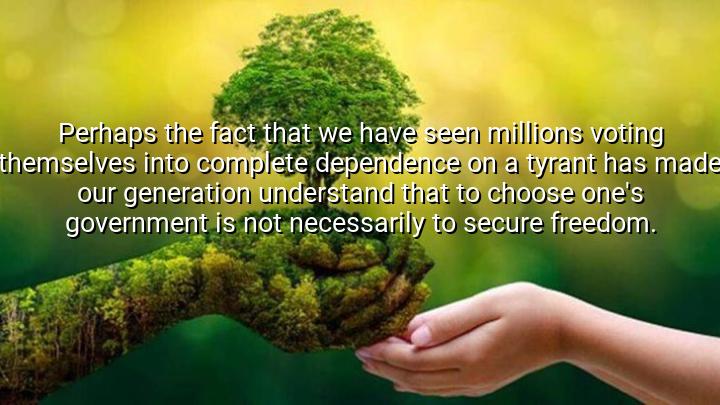




The quote by Friedrich August von Hayek challenges the assumption that the right to vote automatically guarantees freedom. Hayek suggests that simply choosing a government through elections does not ensure that the resulting system will protect individual freedoms. He points to historical examples where millions of people have voted themselves into dependence on a tyrant, meaning that democratic processes can be manipulated or used to install governments that undermine liberty rather than protect it. For Hayek, freedom is not guaranteed by the mere act of voting, but by the structure of the government and the checks and balances in place to prevent the concentration of power.
This statement highlights Hayek’s concern about majority rule and the potential dangers of populism. While the ability to vote is a crucial element of a free society, it can also be exploited if the system allows for the erosion of individual rights under the guise of democratic choice. Hayek warns that people might vote for leaders who promise security or benefits, but in doing so, they might end up trading their liberties for the illusion of stability or control, which ultimately leads to tyranny.
The origin of this quote lies in Hayek's work on political philosophy, particularly in his book "The Road to Serfdom", where he argues that central planning and the concentration of power in the hands of the state lead to the loss of freedom. Hayek was concerned with the rise of totalitarian regimes, even in societies that initially appeared democratic. He believed that economic freedom and political liberty must be safeguarded through decentralized decision-making and limits on government power.
Ultimately, Hayek’s quote emphasizes that freedom cannot be taken for granted even in democratic systems. The act of voting is not a guarantee of liberty if the political system allows for the rise of unchecked power. True freedom is ensured by limiting government overreach, protecting individual rights, and maintaining a system of checks and balances that prevents tyranny from taking hold, even when the majority may choose it.

AAdministratorAdministrator
Welcome, honored guests. Please leave a comment, we will respond soon