

He will therefore have to use what knowledge he can achieve, not to shape the results as the craftsman shapes his handiwork, but rather to cultivate a growth by providing the appropriate environment, in the manner in which the gardener does this for his plants.
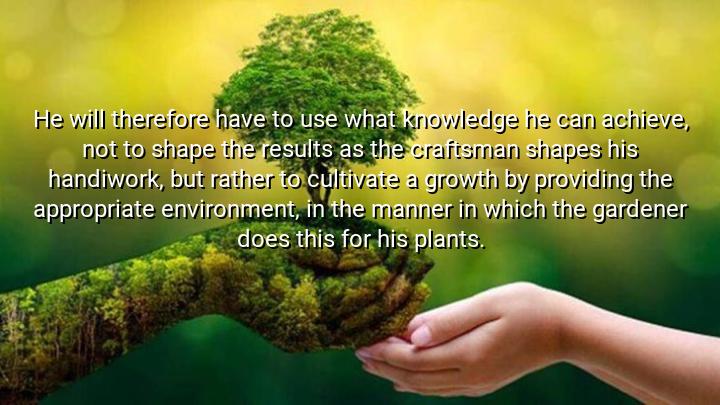




The quote by Friedrich August von Hayek emphasizes the distinction between direct control and facilitation when applying knowledge to complex systems. By stating, “He will therefore have to use what knowledge he can achieve, not to shape the results as the craftsman shapes his handiwork, but rather to cultivate a growth by providing the appropriate environment, in the manner in which the gardener does this for his plants,” Hayek highlights that in many contexts—such as economics, society, or human behavior—it is impossible to precisely control outcomes. Instead, one must focus on creating conditions that allow natural processes to flourish.
Hayek contrasts the craftsman, who actively shapes and designs a finished product, with the gardener, who provides nurturing conditions for growth. The underlying message is that knowledge is limited, and in complex systems, attempts at direct manipulation can be counterproductive. By cultivating the right environment—through rules, incentives, and supportive structures—one allows organic development to occur, yielding results that are often better than those imposed by direct intervention.
Friedrich August von Hayek, a prominent Austrian-British economist and political philosopher, was a leading thinker in economics, political theory, and social philosophy. He is well-known for his work on the limits of knowledge in society and the importance of spontaneous order. This quote reflects his broader belief that social and economic systems are too complex to be centrally designed; instead, success depends on guiding principles and environmental conditions that allow individual actions to aggregate productively.
Ultimately, the quote encourages a humble approach to applying knowledge. It reminds us that in complex systems, the role of a leader, policymaker, or planner is not to dictate exact outcomes but to enable growth through careful design of the environment. Just as a gardener tends to plants without forcing their shape, wise guidance fosters natural, sustainable, and adaptive development.

AAdministratorAdministrator
Welcome, honored guests. Please leave a comment, we will respond soon