

To act on the belief that we possess the knowledge and the power which enable us to shape the processes of society entirely to our liking, knowledge which in fact we do not possess, is likely to make us do much harm.
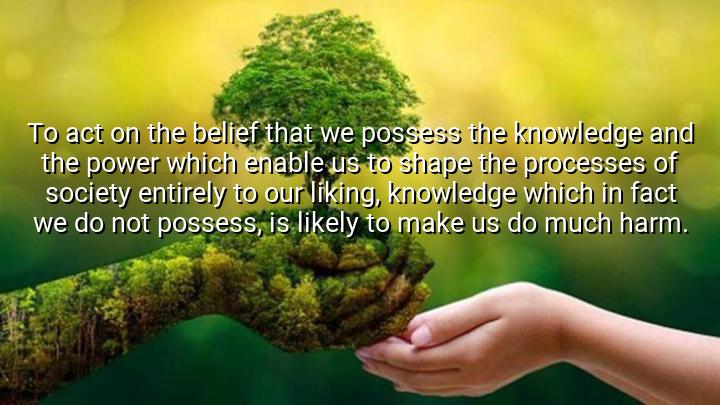




The quote by Friedrich August von Hayek, "To act on the belief that we possess the knowledge and the power which enable us to shape the processes of society entirely to our liking, knowledge which in fact we do not possess, is likely to make us do much harm," reflects a critique of centralized control and overconfidence in social planning. Hayek emphasizes that no individual or group can fully understand the complexity of society, and attempting to manipulate it based on incomplete knowledge can lead to unintended and detrimental consequences.
By highlighting the gap between what we believe we know and what we actually know, Hayek underscores the danger of hubris in governance and policymaking. The quote suggests that well-intentioned actions driven by a false sense of omniscience can disrupt natural social processes, creating outcomes that are worse than the problems they intended to solve. This reflects his broader belief in the importance of spontaneous order and decentralized decision-making.
The origin of the quote comes from Hayek’s work as an Austrian-British economist and philosopher, particularly in his writings on economics, social theory, and political philosophy, such as The Road to Serfdom and Law, Legislation and Liberty. Hayek argued against centralized planning, asserting that complex social and economic systems function best when guided by market mechanisms and distributed knowledge, rather than by the assumptions of a few policymakers.
Ultimately, Hayek’s statement serves as a cautionary principle about humility and prudence in social engineering. It reminds us that power and knowledge are limited, and attempts to impose total control over society can create more harm than good. The quote champions respect for the complexity of human systems and the need to rely on decentralized and informed processes rather than assuming absolute understanding or control.

AAdministratorAdministrator
Welcome, honored guests. Please leave a comment, we will respond soon