

Our Lord has written the promise of resurrection, not in books alone, but in every leaf in springtime.
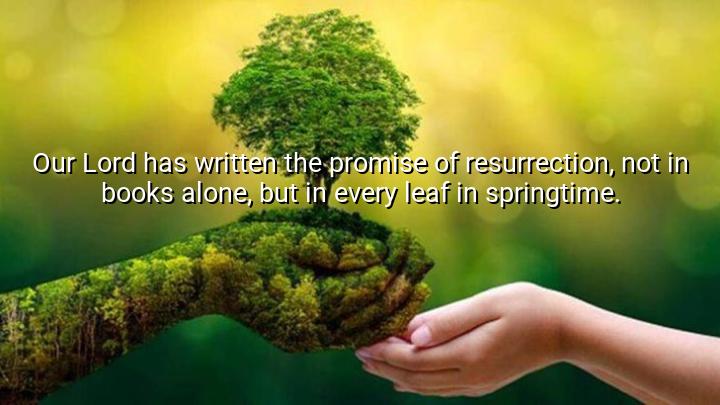




The quote "Our Lord has written the promise of resurrection, not in books alone, but in every leaf in springtime." by Martin Luther reflects a deep connection between nature and spirituality, emphasizing that the promise of resurrection and renewal is not just found in religious texts but also in the cycles of the natural world. Luther, the German theologian and leader of the Protestant Reformation, is suggesting that the evidence of God’s promise is visible all around us, in the growth and rebirth of nature, especially during the season of spring.
Luther uses the imagery of springtime and the growth of leaves to symbolize resurrection—the idea of life returning after death. In the same way that plants and flowers seem to rise from the dead of winter, he sees this as a reflection of the spiritual resurrection promised by God. For Luther, this natural renewal becomes a metaphor for the Christian belief in life after death and the eternal promise of salvation.
The quote also highlights the idea that the message of resurrection is not confined to scripture or religious texts alone, but is something that can be experienced and witnessed in nature itself. Luther’s view suggests that divine presence is not only found in holy writings but is revealed in the everyday world, particularly in the cyclical processes of life, growth, and change. This makes the promise of spiritual renewal more tangible and accessible to people through their connection with the natural world.
Ultimately, Luther’s words invite us to see nature as a reflection of God’s work and creation, emphasizing that the spiritual truths of resurrection and life after death are not abstract concepts but realities that can be witnessed and felt in the world around us. By observing the changing seasons, we can find a deeper, more immediate connection to spiritual renewal and the promise of hope and resurrection.

Hhoangtrunghai
This makes me think about how this view contrasts with strictly textual or doctrinal approaches to faith. Does emphasizing nature’s testimony democratize spirituality, making it more inclusive? How does this shape individual experiences of hope and resurrection, especially for those who find traditional religious texts inaccessible or challenging?
GDGold D.dragon
I’m curious about the historical context of this quote—was Luther addressing a particular audience or challenge? Understanding the circumstances might deepen appreciation for his use of nature imagery to communicate theological ideas. It also raises questions about the role of metaphor in making complex beliefs more relatable.
HGNguy Ha Giang
Could this quote be seen as an encouragement to find spiritual meaning outside formal religious settings? By pointing to nature’s signs, Luther might be inviting believers to recognize God’s presence in the world around them. How might this impact how faith communities engage with their environment and daily lives?
GNQuang Nguyen Gia Nghi
This statement invites reflection on the symbolic power of seasons and natural cycles in religious thought. Spring as a metaphor for resurrection is powerful—how does this symbolism resonate with people of different faiths or even secular beliefs? It seems to bridge the gap between tangible experience and spiritual hope.
VTVo Van Tien
I’m struck by the imagery of ‘every leaf in springtime’ as a testament to resurrection. It evokes a sense of hope and continual renewal. How might this connection between faith and nature influence how people perceive environmental stewardship? Could seeing the natural world as a reflection of divine promises inspire greater care for the planet?