

Our future cannot depend on the government alone. The ultimate solutions lie in the attitudes and the actions of the American people.
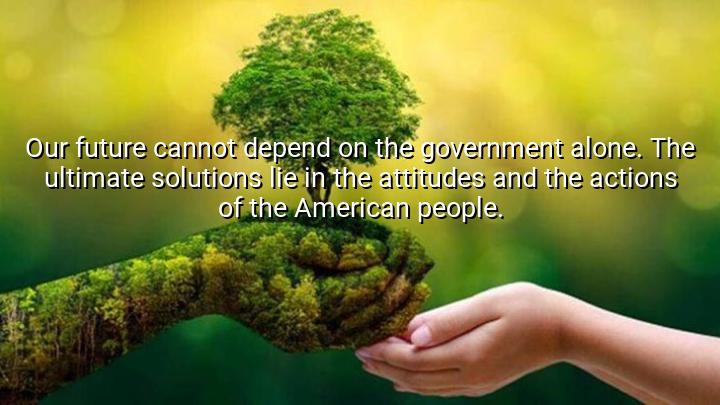




In this quote, Joe Biden emphasizes the importance of individual and collective responsibility in shaping the future of a nation. He suggests that government alone cannot be relied upon to solve the challenges a country faces. While government policies and actions are important, the real change and solutions come from the attitudes and actions of the people themselves. This reflects a belief in the power of the public to influence and drive change, rather than depending solely on political leaders or institutions.
Biden’s statement also points to the role of citizens in creating a better society. He highlights that participation in democracy, community efforts, and personal responsibility are crucial for progress. This reinforces the idea that a thriving democracy requires active involvement from the public, not just passive reliance on government intervention. In other words, the people must take ownership of their own future through positive actions and attitudes.
The quote is particularly relevant in times of political or social challenges, where government action may be slow or ineffective. Biden is reminding citizens that real, lasting change often comes from grassroots efforts, community solidarity, and individuals working together toward common goals. This can include a wide range of actions, from voting and activism to personal efforts to address issues in their communities.
Ultimately, Biden’s words are a call to action and engagement, encouraging citizens to recognize that they are an integral part of shaping the nation’s future. It highlights the idea that collective action and a unified effort are essential for overcoming obstacles and building a more prosperous and just society. By focusing on the attitudes and actions of the people, Biden underscores the importance of citizen empowerment in creating meaningful change.

FFFpt Frt
This quote has a nice balance of humility and motivation. It acknowledges that government can’t fix everything, but also nudges citizens to step up. However, I wonder—do we have the tools and education necessary to take on that responsibility effectively? Civic engagement isn’t innate; it has to be nurtured. How do we create a culture where people not only want to participate but know how to make an impact?
ADVan anh Dang
Reading this, I think of movements like civil rights or marriage equality, which weren’t driven solely by legislation but by the voices and actions of ordinary people. So in that sense, Biden’s quote rings true. Still, I’d love to ask: how can government actively partner with and amplify the efforts of its citizens rather than simply observing or depending on them? There has to be mutual investment.
AABU
There’s an empowering message here that I admire—almost a reminder that democracy isn’t a spectator sport. But at the same time, I think about people who are already stretched thin, working multiple jobs, or dealing with systemic injustice. Can we expect those individuals to drive societal change when they’re just trying to survive? This quote makes me reflect on privilege and capacity as much as it does on unity.
HLDuong Hai Ly
This quote reminds me of how essential community engagement really is. Policy alone can’t solve issues like inequality, climate change, or social division—people have to care and act. Still, I wonder how we foster those 'attitudes and actions' in a society where people are overwhelmed, misinformed, or divided. What does it take to inspire collective will without the feeling that the burden is unfairly shifted to citizens?
TDNguyen Thi Dao
I like the idea here—it puts power back into the hands of the people. But it also makes me a little skeptical. Is this kind of statement sometimes used to shift responsibility away from elected officials? If government leaders ask citizens to step up, shouldn’t they also ensure they’re creating a fair and functional system in which those efforts can make a real difference?