

Nothing can be by itself alone, no one can be by himself or herself alone, everyone has to inter-be with every one else. That is why, when you look outside, around you, you can see yourself.
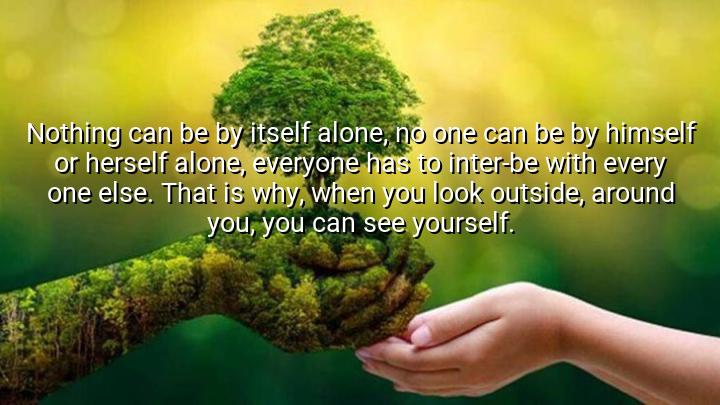




The quote "Nothing can be by itself alone, no one can be by himself or herself alone, everyone has to inter-be with every one else. That is why, when you look outside, around you, you can see yourself" is from Thich Nhat Hanh, a Vietnamese Buddhist monk, peace activist, and author. In this statement, Nhat Hanh emphasizes the interconnectedness of all beings and elements of life. He suggests that no one exists in isolation, and everything—whether people, nature, or objects—is part of an intricate web of relationships and dependence.
Nhat Hanh’s concept of "inter-being" reflects the Buddhist understanding that all phenomena are interconnected. According to this philosophy, nothing has an independent existence but instead exists in relation to everything else. This view challenges the idea of individualism, encouraging a shift toward understanding how our actions and existence are deeply influenced by the relationships we have with others and the world around us. By recognizing that we are not separate but interconnected, we can foster a greater sense of compassion and awareness.
The idea that "when you look outside, around you, you can see yourself" highlights the reflection of our inner selves in the outer world. Nhat Hanh is suggesting that the way we see and interact with others and our environment is a direct reflection of who we are. The people, situations, and nature we encounter are not just external to us, but are mirrors that reflect our thoughts, emotions, and consciousness. This insight fosters a deeper understanding of self-awareness and mindfulness, as we recognize the role we play in shaping the world we experience.
In essence, Nhat Hanh’s quote teaches us that solitude does not exist in its true sense. Instead, interconnection is at the heart of life. We are constantly shaped by and, in turn, shape those around us, both human and non-human. By embracing the idea of inter-being, we develop a more compassionate, mindful relationship with ourselves and the world, understanding that our lives are deeply intertwined with everything else in existence.

TTTieu Tranh Tu
This quote is poetic and thought-provoking, but it raises a practical question for me: in a society that prizes independence, how do we begin to reframe our value systems around interdependence without feeling like we're giving something up? It feels like a big mental shift, and I wonder how this philosophy could be integrated into education or even politics to encourage more mindful coexistence.
NATran Thi Ngoc Anh
I find this quote incredibly grounding. It suggests that the illusion of separateness is just that—an illusion. But if we’re all so intertwined, does that change how we approach conflict and misunderstanding? Should we be more focused on healing the collective rather than defending individual viewpoints? I wonder how different the world would be if we truly lived by this principle, especially in polarized societies.
Hhthh
This idea of 'inter-being' is both beautiful and overwhelming. It means our actions ripple outward in ways we can’t fully see. But does this level of interconnectedness mean we’re also responsible for others' suffering? Where do we draw the line between compassion and emotional burnout? I think this quote opens up an important discussion on how to stay connected while also maintaining our emotional well-being.
GKTran Gia khang
Reading this made me think about how much of ourselves we see in others—both the good and the uncomfortable parts. If we're reflections of one another, does that mean our reactions to others are often about ourselves? That’s a bit unsettling, but also a powerful lens for empathy. I’m curious—can this perspective help us be less judgmental and more compassionate in our day-to-day interactions?
QTDau Quynh Trang
This quote is so profoundly humbling. It challenges the Western idea of individualism and reminds me that we're all deeply interconnected. But it also makes me wonder—how do we reconcile this with the need for personal boundaries and solitude? Is there a way to embrace our interdependence without feeling like we’re losing our sense of self? I’d love to explore how this philosophy plays out in modern relationships and communities.