

No one else can take risks for us, or face our losses on our behalf, or give us self-esteem. No one can spare us from life's slings and arrows, and when death comes, we meet it alone.
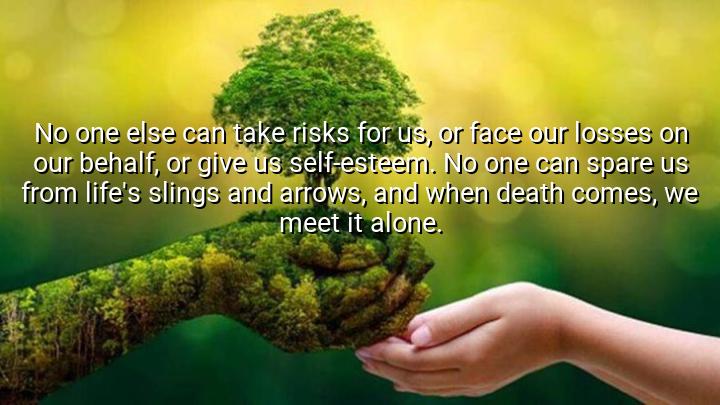




In this quote, Martha Beck underscores the personal responsibility and individuality inherent in life's journey. She states that no one else can take risks for us, face our losses, or give us self-esteem, emphasizing that these are deeply personal experiences that we must navigate alone. Beck is reminding us that while we may receive support from others, the core aspects of personal growth, decision-making, and facing challenges are ultimately our own responsibility.
The phrase "no one can spare us from life's slings and arrows" further illustrates the inevitability of hardship and pain in life. The slings and arrows symbolize the difficulties and trials we must all face at various points in our lives, whether they come in the form of emotional, physical, or existential challenges. Beck suggests that these struggles are unavoidable and cannot be mitigated or taken away by others.
Finally, Beck brings the inevitable reality of death into the picture, stating, "when death comes, we meet it alone." This highlights the ultimate solitude of the human experience. No matter how many relationships or connections we form throughout life, the final moments are something that we must face on our own. This notion reinforces the idea that personal growth, responsibility, and even the end of life are solitary experiences, defined by our own choices and actions.
Ultimately, Beck’s quote is a reminder of the importance of personal agency and the need to take ownership of our own lives. While others may influence us and offer support, it is our own decisions, actions, and self-acceptance that shape our experiences. The quote encourages us to embrace the solitude of life, recognizing that we are the ones who must face its challenges and ultimately, its end.

YNchu hoang yen nhi
This quote struck a nerve. It’s a reminder that self-worth and resilience aren’t gifts anyone can hand us—they’re cultivated from within. But how do we develop those qualities in a world that often encourages dependency or external validation? And what role do role models or therapy play in helping us build that foundation? It’s a powerful idea, but I’m curious about the practical path to embracing it fully.
TVToan Trieu van
Isn’t this quote a little too heavy-handed? I get the message—it’s about personal responsibility and the inevitability of death. But isn’t there value in the support we get from others, even if they can’t take our place? It feels like the quote might unintentionally diminish the real comfort and impact of companionship. Can’t shared vulnerability and empathy make the journey feel less lonely, even if the steps are ours alone?
PVPhong Vuba
Reading this makes me feel a mix of awe and fear. It’s true—we are ultimately alone in our choices and our fate. But is that a reason to isolate ourselves emotionally, or a call to strengthen our inner selves so we can be more present with others? How do we find peace in the face of this existential solitude without falling into despair or apathy? It’s a tough but meaningful reflection.
NLNguyen Ngoc Linh
I find this quote incredibly grounding. It reminds me that while support systems are vital, we can’t delegate the essential inner work of life. But I’m torn—does this perspective unintentionally promote isolation or hyper-individualism? How do we balance the necessity of facing our own struggles with the importance of community and connection? I’d love to hear thoughts on how to hold both truths without dismissing either.
BNBao Ngoc
This quote feels both sobering and empowering. On one hand, it emphasizes the solitude of personal responsibility, which can be daunting. On the other, it highlights our agency—we are the ones who must make meaning of our lives. But I’m wondering, does this view overlook the value of relationships? Can’t love, friendship, or mentorship ease the burden, even if they can’t carry it entirely for us? Is total self-reliance even realistic?