

No man is an island. No man stands alone.
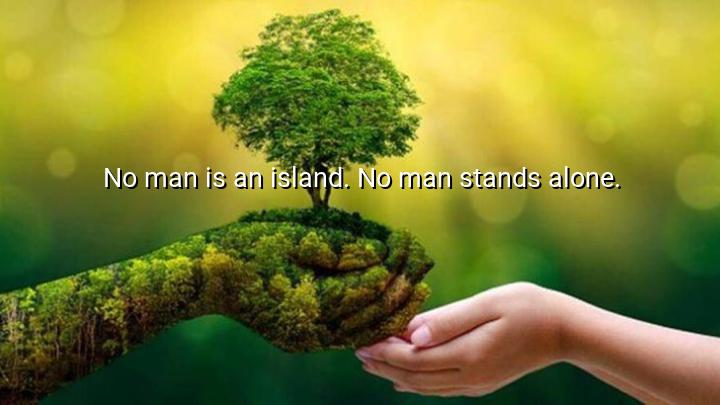




In this quote, Dennis Brown emphasizes the essential interdependence of human beings, suggesting that no person is entirely self-sufficient. The phrase "No man is an island" conveys the idea that humans are inherently social creatures, relying on others for support, connection, and growth. Brown is highlighting the importance of relationships and community, underscoring that even those who seem isolated or independent still depend on others, whether for emotional, physical, or social needs.
The second part of the quote, "No man stands alone," reinforces this notion by asserting that individuals cannot thrive or fully fulfill their potential in isolation. Everyone is influenced by others, whether through family, friends, colleagues, or society at large. The idea of standing alone suggests a sense of vulnerability and disconnection, which, according to Brown, is not a natural or sustainable state for a person.
Brown’s words suggest that support and connection are vital for emotional and social well-being. In this sense, the quote serves as a reminder that it is through the bonds we form with others that we find strength, purpose, and fulfillment. It challenges the idea of extreme individualism, instead promoting a sense of shared humanity and mutual support.
Ultimately, Brown’s quote reinforces the idea that humanity is built on collaboration, compassion, and the recognition that we are not truly independent from one another. It is a call to recognize the value of community and the role others play in our lives, reminding us that no one truly thrives in isolation.

Kkimmy
From a personal standpoint, this quote makes me question how often I reject help in the name of pride or self-reliance. Why is it so hard to admit we need others? Is vulnerability seen as weakness in a world that prizes individualism? Maybe recognizing that we don’t stand alone isn’t just about gratitude—maybe it’s a challenge to be more honest with ourselves and more open to connection.
LKLe Khoi
I can’t help but think about global challenges when I read this—climate change, pandemics, poverty. Problems that one person can’t solve alone, but still affect everyone. Do you think this quote could be a call to action? Like a reminder that we're all part of something bigger, and that pretending we're isolated won't save us? I find it strangely motivating, like a quiet push toward collective accountability.
AThoang dieu anh thu
This reminds me of how we often overlook the unseen networks that make our lives possible—family, friends, coworkers, even strangers. But what about people who feel isolated or disconnected? Does this quote invalidate their experiences or offer them hope? I’m curious how people who are estranged or marginalized interpret this. Can someone who feels like they stand alone still find strength in the idea that, ultimately, none of us truly do?
DNDat Nguyen
It's a comforting thought in some ways, but also a bit daunting. If no one truly stands alone, do we carry a responsibility to always be there for others, even when we're struggling ourselves? Where do we draw the line between supporting others and protecting our own mental space? This quote makes me think about emotional labor and the sometimes invisible weight of being part of a larger social fabric.
ANtram anh nguyen
This quote really speaks to the importance of community and human connection, but I wonder—how does this idea hold up in cultures that celebrate hyper-independence? Are we fooling ourselves by thinking we can succeed entirely on our own, or does modern society push people to value autonomy over interdependence? It makes me reflect on whether loneliness today stems from ignoring this basic truth about our need for each other.