

No enterprise can exist for itself alone. It ministers to some great need, it performs some great service, not for itself, but for others; or failing therein, it ceases to be profitable and ceases to exist.
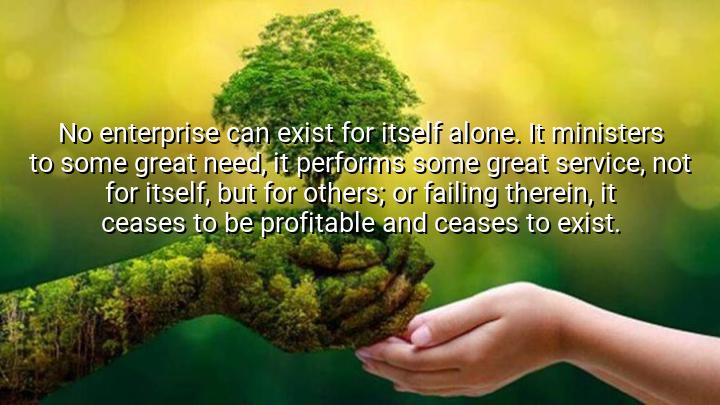




The quote "No enterprise can exist for itself alone. It ministers to some great need, it performs some great service, not for itself, but for others; or failing therein, it ceases to be profitable and ceases to exist." by Calvin Coolidge emphasizes the idea that the success and sustainability of any business or enterprise depend on its ability to serve a greater purpose beyond its own interests. Coolidge argues that businesses thrive when they meet the needs of society, offering value and service to others. If a business only focuses on self-interest and fails to address a broader need, it will eventually fail, as it loses its ability to remain relevant and profitable.
This statement reflects the principle of service in business—emphasizing that companies should not view their purpose merely as making a profit for their own benefit, but as contributing something valuable to the community or society at large. When businesses lose sight of this, they risk becoming unsustainable. Coolidge is highlighting that social responsibility and purpose are critical components of any successful enterprise.
The quote also touches on the broader concept of interdependence. Coolidge suggests that no entity exists in isolation; every business or organization is connected to the world around it and must contribute to the greater good to remain viable. This interdependence means that businesses must operate with a sense of ethics and social impact, understanding that their success is tied to the well-being of others.
The origin of this quote comes from Calvin Coolidge, the 30th President of the United States, known for his conservative policies and emphasis on economic growth. As president, Coolidge believed in free market capitalism, but also acknowledged that businesses must serve the public interest. This quote reflects his belief in a balanced approach to capitalism, where profit and social good go hand in hand, and enterprises are ultimately judged by their ability to meet the needs of society.

TNNguyen Thi Nguyet
I wonder how this perspective influences leadership and decision-making within organizations. Should CEOs prioritize social service as much as financial performance? How might this change internal company culture and external branding? Could emphasizing ‘service to others’ create more resilient businesses, especially in times of economic uncertainty or crisis?
ANAnh Nguyen
This quote resonates with the idea of purpose-driven business, but how do you think it applies to global corporations versus small local businesses? Do smaller enterprises have an advantage in directly meeting community needs, or can large companies leverage scale for greater good? How do cultural and economic contexts influence what is considered a ‘great need’?
TNTrung Nam
Coolidge’s statement raises questions about the ethical foundations of commerce. In what ways can enterprises fail to recognize the ‘great need’ they serve? Are there industries or companies that survive despite neglecting societal benefit, and if so, how sustainable is their model? Could government regulation or consumer activism enforce this principle more effectively?
PTP.Thuong Phan Thi
The idea that an enterprise must serve others or cease to exist highlights sustainability beyond finances. Could this philosophy be applied to startups and nonprofits alike? How might businesses measure their social impact as rigorously as their financial results? Does this shift in focus risk detracting from profit, or can it create long-term value and loyalty?
ML23. Do Mai Linh
This quote makes me question how deeply businesses understand their role beyond profit. Do you believe that fulfilling ‘some great need’ should be the primary goal, or is that idealistic in competitive markets? How can companies innovate in ways that genuinely serve others rather than merely creating demand? What responsibilities do consumers have in supporting businesses that minister to real needs?