

Most women would not be happy being me. People say, 'But you're alone.' But I don't feel alone. I feel very un-alone.
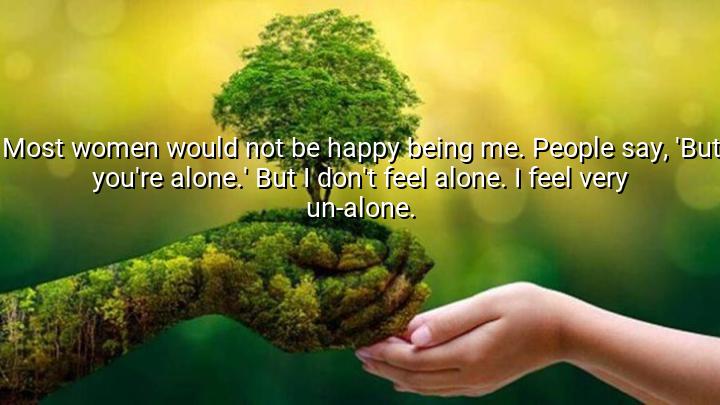




The quote "Most women would not be happy being me. People say, 'But you're alone.' But I don't feel alone. I feel very un-alone." is from Stevie Nicks, an iconic American singer and songwriter best known for her work with Fleetwood Mac and her successful solo career. In this statement, Nicks reflects on the idea of solitude and how she experiences it differently from others. Despite the common perception that being alone is a source of sadness or loneliness, Nicks asserts that she doesn’t feel lonely at all. Instead, she feels fulfilled and connected, even in her solitary moments.
Nicks suggests that while society often associates being alone with unhappiness or isolation, her personal experience is quite the opposite. The phrase "I feel very un-alone" reflects her sense of inner peace and self-contentment. For Nicks, solitude is not something negative but a space where she can feel connected to her own emotions, creativity, and inner world. This contrasts with the typical view that individuals must be in relationships or social settings to feel complete.
The line "Most women would not be happy being me" hints at the societal pressures women often face to conform to expectations around relationships, family, and companionship. Nicks is acknowledging that her independence may not be something that all women would embrace, especially in a world where there is often an emphasis on connection and being in partnership. However, she is clear that her happiness does not depend on these societal norms.
In essence, Nicks’ quote challenges traditional views of solitude and happiness, showing that being alone does not have to equate to loneliness. She emphasizes that true contentment comes from self-awareness and inner strength, and that the ability to embrace solitude can lead to a profound sense of wholeness and connection to oneself.

NNGA
Wow, I felt a mix of awe and sadness reading that. On one hand, it's empowering to see someone so confident in their solitude. On the other, I wonder—has she truly never wanted long-term companionship, or has she simply learned to live without it? Is it strength, resignation, or both?
QQuynh
That quote really makes me reflect. Why do people assume being alone is a problem that needs fixing? If someone feels whole and complete on their own, isn’t that just as valid a life as one filled with people? Do you think our discomfort with solitude says more about us than the person who chooses it?
KPGia Khang Phan
I admire the sense of empowerment in her words, but it makes me wonder—how do we differentiate between healthy solitude and emotional isolation? Can feeling 'un-alone' come from deep self-acceptance, or does it require a spiritual or artistic outlet like Stevie has through her music?
THThanh Huyen
This quote makes me curious: how does one reach that level of self-containment? Is it something we’re born with, or is it cultivated through life experiences and personal growth? I’d love to hear more about how Stevie Nicks developed this mindset, and whether it was always this way or came with time.
TVDinh Tong Viet
I'm really struck by the confidence and peace in that statement. But it also makes me wonder—do you think the reason most women wouldn’t want her life is because of how society defines success and happiness, especially for women? Are we still measuring fulfillment based on outdated expectations like marriage and constant companionship?