

Man is a creature who lives not upon bread alone, but primarily by catchwords.
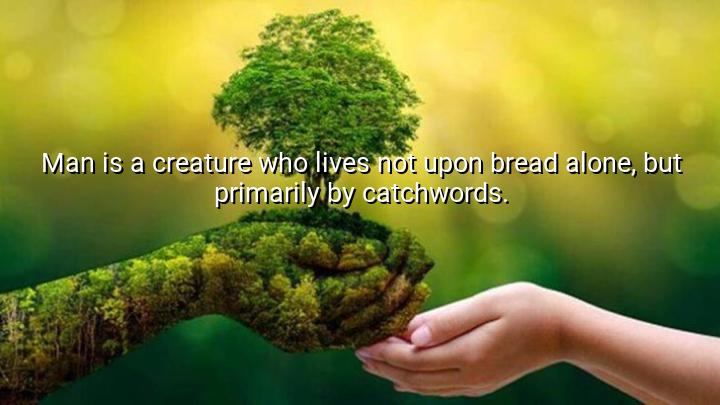




The quote "Man is a creature who lives not upon bread alone, but primarily by catchwords." by Robert Louis Stevenson suggests that human beings are not just driven by basic physical needs, like food (bread), but are also profoundly influenced by language, ideas, and catchwords—short, catchy phrases or slogans that carry significant emotional or cultural weight. Stevenson, a Scottish author best known for works like Treasure Island and The Strange Case of Dr Jekyll and Mr Hyde, highlights how language shapes human behavior, influencing people far more than mere material sustenance.
Stevenson’s use of "catchwords" reflects how society is often swayed by simplified concepts, ideologies, or popular sayings that are easy to remember and repeat. These phrases, while not always deeply meaningful, hold power over individuals and can drive social or political movements. They act as tools to unite people, shape opinions, and sometimes manipulate or influence the masses, often without individuals even fully understanding the ideas behind them.
The comparison to bread suggests that while food is necessary for survival, catchwords are essential for social survival. They feed the mind, provide comfort, and help people navigate the complexities of society. Just as bread nourishes the body, catchwords nourish the mind, providing easy answers or shortcuts to understanding complex issues. However, Stevenson seems to imply that this reliance on superficial language can sometimes detract from deeper, more thoughtful engagement with important issues.
Ultimately, Stevenson’s quote points to the power of language and the influence of simplified narratives on human behavior. He suggests that while people may claim to value reason and intellectual engagement, they are often swayed more by the appeal of catchy phrases and the ease with which they can be absorbed and repeated. This reflects a critique of how modern society prioritizes quick fixes and shallow understanding over deeper reflection and intellectual growth.

0G06 Gieng
I’m curious about how this idea applies to education and leadership. If people live by catchwords, how can educators and leaders craft messages that are both compelling and truthful? What is the impact of memorable language on motivating action or fostering understanding? It’s a powerful reminder of language’s dual power to nourish and deceive.
SS3mp
This statement makes me think about the role of culture and ideology in human life. ‘Catchwords’ might represent shared values or identity markers. How do these linguistic tools build communities or create divisions? It raises questions about how language shapes our social realities and personal identities.
LCLe Chau
Could this quote be seen as a critique of how easily people are swayed by popular rhetoric? It seems to suggest that humans seek more than just physical sustenance—they crave ideas that resonate or inspire. How might this insight help us become more critical consumers of information and resist manipulation?
KVKhoa Vui
I’m intrigued by the suggestion that people rely heavily on slogans or buzzwords. Does this imply a tendency to favor quick, digestible ideas over deeper understanding? How does this shape public discourse and decision-making? It makes me think about the balance between catchy communication and substantive content in influencing minds.
TVLe thi vit
This quote cleverly points to the power of language and ideas in sustaining humans beyond mere physical needs. I wonder how ‘catchwords’ influence our beliefs and behaviors today, especially with the rise of social media and viral slogans. Are we nourished by meaningful dialogue, or do catchy phrases sometimes oversimplify complex truths? It invites reflection on the responsibility that comes with using language effectively.