

Man does not live by words alone, despite the fact that sometimes he has to eat them.
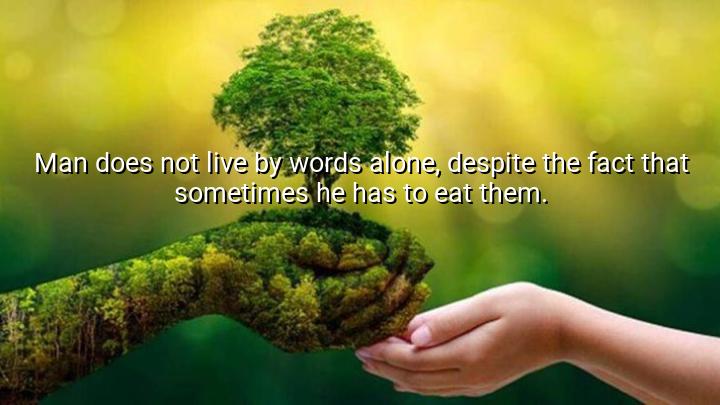




The quote "Man does not live by words alone, despite the fact that sometimes he has to eat them" is from Adlai Stevenson II, an American politician, diplomat, and two-time presidential candidate. In this statement, Stevenson emphasizes that words—while important—are not enough to sustain a person in life. The phrase "man does not live by words alone" suggests that, in the end, actions are more significant than mere talk. Words can be powerful, but they need to be backed up by meaningful actions to have true impact.
The second part of the quote, "despite the fact that sometimes he has to eat them," adds a layer of irony and humor. It implies that people often say things they later regret or are forced to take back. The expression "eating one's words" refers to the act of admitting a mistake or retracting a statement. Stevenson suggests that while words are not enough to sustain us, they can come back to haunt us when they are not well-considered or when circumstances change.
Stevenson’s words may also reflect his own experience in politics, where promises and speeches are frequently made, but the reality of governing requires action and accountability. His statement highlights the tension between rhetoric and reality—how words are used to persuade, but they can easily fall short when not supported by deeds.
In essence, Stevenson’s quote offers a pragmatic view on the importance of action over mere talk. While words can inspire and inform, they must be followed by practical efforts to truly make a difference. And, as the quote humorously points out, sometimes we must face the consequences of our words when they are not carefully chosen.

TCHoang Trung Chinh
What a clever way to highlight the ego’s vulnerability. It’s funny how words can elevate or embarrass us depending on how the future unfolds. Does this quote suggest that wisdom lies not in never being wrong, but in accepting when you are? And how does one stay open to correction while still speaking with confidence and conviction?
HKnguyen hoang kien
This quote brilliantly captures the tension between idealism and reality. Words inspire, persuade, and lead—but when they outpace our capacity to follow through, they can backfire. It makes me wonder, especially in leadership or politics, how do you balance the power of language with the weight of accountability? Should people speak less, or just be more willing to take responsibility later?
NTle vu nhat tan
I find this quote kind of comforting in its honesty. Everyone eventually contradicts themselves, makes promises they can’t keep, or speaks without thinking. But it’s also a reminder that being wrong doesn’t have to be shameful—just part of being human. Could we foster a more forgiving culture if we normalized the idea that 'eating your words' is part of learning?
QTQuynh Thai
This quote makes me think about how words and actions interact. Stevenson seems to be saying that talk is cheap—but sometimes your own words become the consequences you have to live with. I wonder, are we too quick to speak in certainty before truly understanding a situation? And is there enough room in public discourse for people to walk back their words with grace?
Ddatdepzai
I love how this quote balances humor with wisdom. It reminds me that words are powerful, but they can also trap us. We often forget that expressing opinions carries a long shelf life—especially in the digital age. What happens when our past words resurface, and we're forced to ‘eat’ them in front of the world? Can doing so ever be viewed as strength rather than failure?