

Loneliness is, like, when you wish someone else was there, and solitude is when you enjoy being alone. I don't always wanna be alone, but I definitely like pockets of solitude to recharge and come back to myself. I think that's so important for everyone.
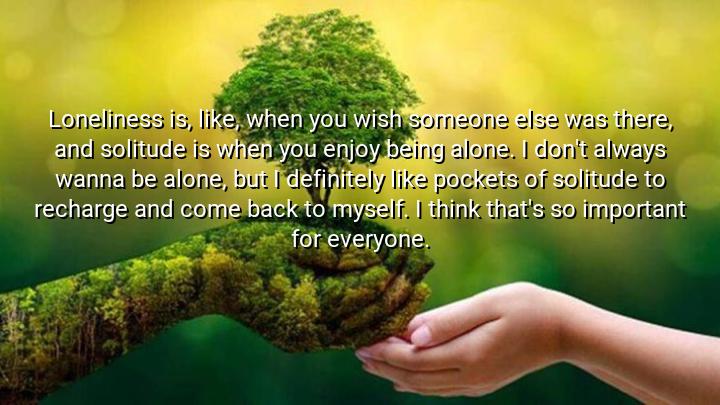




In this quote, Jonathan Van Ness, a television personality known for his role on Queer Eye, distinguishes between loneliness and solitude. He explains that loneliness is the feeling of wanting someone else to be with you, typically when you feel isolated or disconnected, while solitude is the choice to be alone and enjoy your own company. Van Ness emphasizes that solitude is a positive and empowering experience, allowing individuals to recharge and reconnect with themselves, while loneliness is something that can feel more negative and unwanted.
Van Ness further reflects on the balance between social interaction and personal time, acknowledging that while he doesn't always want to be alone, he still values pockets of solitude as an essential part of his well-being. These moments of alone time are crucial for him to regain energy, refocus, and come back to his center. The quote highlights the importance of carving out time for self-reflection and personal growth, especially in a world that often demands constant interaction and stimulation.
The idea that solitude is necessary for self-care and personal reflection is key to the quote’s message. Van Ness suggests that everyone can benefit from taking time to be alone, allowing for a mental reset that helps maintain emotional balance. This concept underscores how solitude can be an opportunity for growth, creativity, and inner peace, allowing individuals to better understand themselves and return to the world with a refreshed perspective.
Ultimately, Van Ness’s quote champions the idea that solitude is not inherently negative, but an essential practice for recharging and preserving mental health. It encourages people to embrace the power of being alone in small, intentional doses, reminding us that solitude is not about isolation, but about reconnecting with who we are and taking care of our emotional well-being.

BDThuan Bui Duc
Van Ness puts something into words that I’ve always struggled to explain—how being alone can feel either peaceful or painful depending on the context. I wonder what factors influence that shift for different people. Is it personality type, emotional state, life experiences? And how can we build the emotional awareness to know when we need solitude versus when we actually need connection?
TDNGO THI DIEU
This quote got me thinking: can solitude actually help us become better in our relationships? I find that when I take time alone, I show up more present and grounded for others. But society often sees time spent alone as selfish or antisocial. Should we be teaching the value of solitude as a tool for self-connection and emotional resilience, especially to younger generations growing up constantly online?
GBgia bao
I appreciate the emotional intelligence in this quote. It acknowledges that even people who love alone time don’t want to be isolated all the time. That balance is so tricky, though. How do you communicate that you need solitude without making others feel rejected? I’d love to hear how others set boundaries around their alone time while maintaining close relationships.
HMPhan Nguyen Ha My
This really resonates with me, especially as someone who needs regular alone time to recharge. It’s refreshing to hear solitude framed as something positive rather than a social deficiency. But I wonder, in a culture that values constant connection and busyness, are people even given the space to experience solitude anymore without guilt or judgment? Maybe we need to normalize unplugging for the sake of self-renewal.
NTTran Nhat Tan
I love how simply this quote differentiates between loneliness and solitude—it's such a relatable distinction. But it makes me wonder, do we always know when we’ve crossed the line from one into the other? Sometimes solitude can slowly morph into loneliness without us realizing it. How do we stay tuned in enough to catch that shift and respond in a healthy way before it weighs on our mental health?