

Let your mind alone, and see what happens.
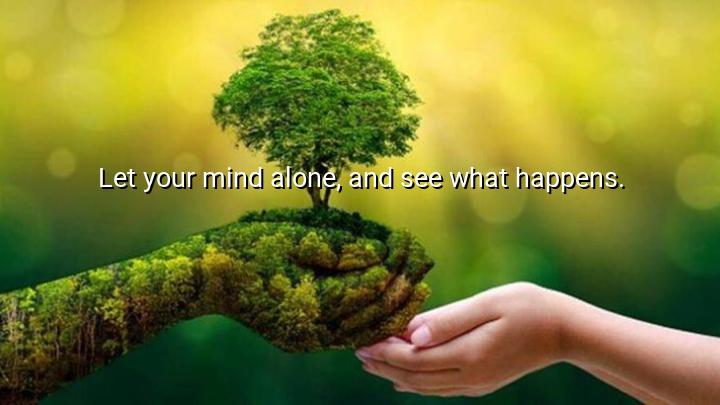




The quote "Let your mind alone, and see what happens" by Virgil Thomson invites us to consider the power of mental stillness and non-interference. Rather than constantly trying to control, force, or shape our thoughts, Thomson suggests stepping back and allowing the mind to unfold on its own. This reflects a belief in the natural creativity and insight that can emerge when we stop overthinking and simply observe.
Virgil Thomson was a 20th-century American composer and music critic, known for his experimental approach to both music and thought. His work often challenged traditional forms, embracing the idea that spontaneity and freedom lead to genuine expression. This quote aligns with that spirit—it encourages a kind of mental openness, a willingness to trust the process rather than constantly direct it.
The phrase also echoes ideas found in Eastern philosophy, especially Zen Buddhism, where practitioners are taught to let go of effortful control and simply become aware of the present moment. In this context, “letting your mind alone” allows space for clarity, inspiration, and even healing. It is a quiet rebellion against the modern urge to be constantly productive or mentally busy.
Ultimately, this quote is a gentle reminder to allow the subconscious and intuition some room to breathe. Whether in art, problem-solving, or daily life, stepping back can sometimes lead to the most unexpected and insightful discoveries. It speaks to the value of patience, trust, and letting the mind do what it was designed to do—think, feel, and create, without constant interference.

MLnguyen mai linh
There’s something quietly rebellious about this quote. In an age of endless self-optimization, it’s almost taboo to leave your mind alone. But what if that's where real creativity and originality hide—in the unedited stream of consciousness? I’d love to try this as an experiment: no journaling, no planning, just observing my mind. Would it be enlightening or uncomfortable?
NHnhu hoai
I love the openness of this line—it almost dares us to embrace the unpredictability of our own minds. But I wonder, is everyone comfortable doing that? For people with anxiety or intrusive thoughts, 'letting the mind alone' might not feel freeing—it could be overwhelming. How do we balance acceptance of thought with the need for mental wellbeing?
THThuong Hoai
This quote really challenges the way I usually treat my thoughts. I tend to analyze, correct, and structure them constantly. But what if there's value in simply observing without interference? Could that lead to more authentic ideas or emotional clarity? Or is there a risk that unfiltered thinking just reinforces negative patterns without reflection?
SMSano Majiro
It’s such a curious suggestion. Let your mind alone—does that mean stop overthinking, stop resisting, or just stop interfering? It reminds me of mindfulness practices where you observe thoughts without judgment. But is that what Thomson meant, or is it more about trusting subconscious creativity? Either way, I wonder what role intuition plays when we stop micromanaging our own minds.
TMDuong Thi Tra My
This quote fascinates me—it feels like an invitation to surrender control and observe the natural rhythm of thought. But I’m curious, does letting the mind roam freely lead to insight or chaos? In a culture that constantly pushes productivity and mental discipline, this idea feels almost radical. What might we discover if we stopped trying to manage every thought and simply listened?