

Leave the atom alone.
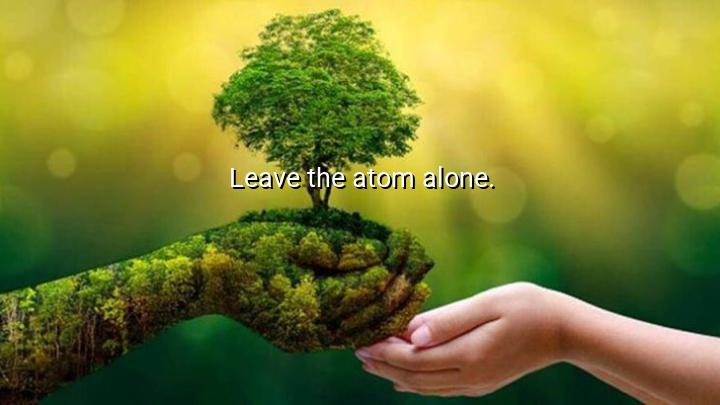




In this quote, E. Y. Harburg, a songwriter and lyricist, urges others to "leave the atom alone," which can be interpreted as a warning against the reckless manipulation of nature and the forces that govern it. Harburg's plea suggests that humans should not tamper with or interfere with the fundamental building blocks of matter—the atom—which could have unforeseen consequences. In a broader sense, this could be seen as a call for caution in the pursuit of scientific and technological advancements, particularly those that deal with the fundamental forces of the universe.
Harburg’s statement may also reflect his concerns about the misuse of scientific power and the potential dangers of experiments that alter the natural order. The phrase "leave the atom alone" could be a subtle critique of the burgeoning nuclear age in the mid-20th century, a time when nuclear weapons and atomic energy were becoming prominent. Harburg was known for his witty and socially conscious lyrics, so this quote might have been a way of commenting on the ethical implications of scientific progress.
The quote could also be interpreted as a cautionary remark about the limits of human knowledge and the dangers of overreach. While scientific exploration and innovation have the potential to improve lives, Harburg might be emphasizing that not every aspect of nature should be manipulated or tampered with, especially when it involves powerful and potentially destructive forces like those found at the atomic level. It’s a reminder of the responsibility that comes with understanding and harnessing such potent energy.
Ultimately, Harburg’s quote advocates for humility and responsibility in the face of scientific discovery. By urging others to "leave the atom alone," he calls for a careful balance between scientific curiosity and the ethical considerations that must guide human intervention in the natural world. This reflects a broader theme of respecting the unknown and acknowledging the potential consequences of altering the most fundamental elements of life.

THnguyen thi thuy hoa
Could this quote also be seen as a metaphor for over-analysis or control? Maybe the 'atom' stands for something pure and fundamental that shouldn't be dissected or dominated. It reminds me of how sometimes we lose the beauty of things by trying to break them down too much. Whether in science, relationships, or nature—maybe there’s value in letting some things just be. Does every truth need to be uncovered?
HLNguyen Hoang Long
Honestly, this quote feels like a critique of militarism more than science itself. The atom, as a symbol, represents raw potential—but also the horrors of what governments have done with that potential. Maybe Harburg wasn’t condemning curiosity, but the weaponization of discovery. That leads me to ask: in a world still bristling with nuclear arms, have we really learned anything? Or are we still playing with fire, hoping not to get burned?
APLe Anh Phuong
Such a tiny sentence, but it echoes decades of fear and moral debate. I immediately think of Hiroshima, Chernobyl, and the Cold War. Was Harburg tapping into a deeper anxiety about human arrogance—our tendency to manipulate nature without foresight? At the same time, we've also used atomic knowledge for energy and medicine. So is the quote too absolute? Or is it simply a poetic way of saying: proceed with reverence?
TATrang Anh
This makes me wonder whether Harburg was speaking literally, politically, or philosophically. Is this a commentary on nuclear weapons, or could it also be a metaphor for not disrupting fundamental natural orders? In today’s world of genetic editing and AI, this quote feels more relevant than ever. Are there boundaries in science we should never cross, or does progress always come with risk? Who gets to decide where that line is?
TT9a4 Thanh Tai
I can’t help but hear this as a plea for restraint in science, especially in areas where discovery has the potential to destroy. But then, how do we balance curiosity with caution? The atom has brought both progress and peril. Should we have left it untouched, or is it our ethical responsibility to manage the knowledge responsibly once it’s known? Is the issue really the atom—or the people wielding it?