

Know then this truth, enough for man to know virtue alone is happiness below.
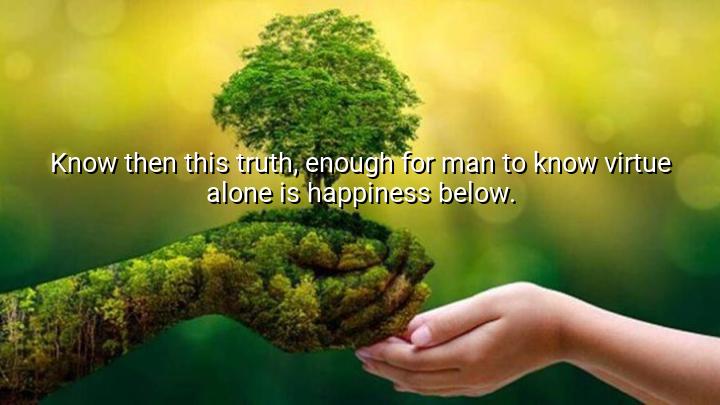




In this quote, Alexander Pope, an 18th-century English poet, expresses the idea that virtue is the true source of happiness for human beings. He suggests that, in the pursuit of happiness, one need not seek wealth, fame, or pleasure, but rather focus on cultivating virtue—moral excellence and righteousness. For Pope, happiness does not depend on external circumstances or material possessions, but on the inner quality of one’s character and actions, emphasizing the timeless idea that moral integrity brings true peace and contentment.
Pope's assertion aligns with the philosophical Stoic tradition, which teaches that happiness comes from living in accordance with nature and virtue rather than seeking fleeting pleasures. This perspective challenges the prevailing cultural emphasis on wealth, status, or personal gratification, advocating instead for the pursuit of ethical living and self-discipline. Pope's message is that internal peace and satisfaction are the ultimate goals of life, and that these can only be achieved by prioritizing moral values over external rewards.
The quote also highlights the relationship between knowledge and virtue. Pope suggests that knowing the truth about what constitutes real happiness—which is rooted in virtue—can guide individuals toward a fulfilling life. This knowledge, in his view, is crucial for anyone who wishes to attain true contentment and avoid the misguided pursuit of shallow pleasures or superficial achievements.
Ultimately, Pope’s quote is a call to focus on the development of virtue as the key to lasting happiness. By placing moral character and ethical living at the core of one’s life, Pope argues, individuals can find true fulfillment and joy, transcending the fleeting satisfactions offered by the material world. The message encourages a shift in focus from external success to internal growth and moral integrity as the foundation for a meaningful life.

THVu The Hoang
This quote really challenges modern values. We live in a time where success is often measured by wealth, fame, or influence. So Pope’s assertion feels radically countercultural. Do we even believe this anymore? Or has our idea of happiness become so entangled with achievement that we can’t see virtue as fulfilling in itself? It makes me wonder if we need to rethink what we’re actually chasing in life.
HLHomnay Luu
There’s a kind of noble simplicity in this line that I respect. But practically speaking, can a person really be happy just by being virtuous, especially if they’re surrounded by corruption or hardship? I want to believe that inner goodness is enough, but in reality, doesn’t happiness also depend on external support and community? Is virtue truly self-sustaining, or does it need a nurturing environment to bring joy?
DDQuoc Duy Dinh
This quote feels almost philosophical to the point of being austere. Is it suggesting that joy from relationships, creativity, or even beauty are secondary to virtue? I’m torn. I value moral living, but I also find deep happiness in experiences that aren’t necessarily moral acts. Is Pope narrowing the definition of happiness too much here, or is he pointing to a deeper, more lasting form of contentment?
MTMai Tho
I love how this quote simplifies the pursuit of happiness, but it also raises a question—what happens when living virtuously actually causes pain or loss? Think of whistleblowers, activists, or anyone who does the right thing at great personal cost. Does virtue still equal happiness in those moments, or is this a long-term promise? Maybe true happiness through virtue is more about peace with oneself than pleasure or comfort.
TTHuynh Thanh Thao
There’s something comforting and timeless in this quote, but I’m curious: how do we even define 'virtue' today? It feels like such a subjective concept now, varying across cultures, belief systems, and generations. If happiness is rooted in virtue, but we can’t agree on what virtue is, are we all chasing different versions of happiness? Is there a universal moral core we can all agree on?