

Justice cannot be for one side alone, but must be for both.
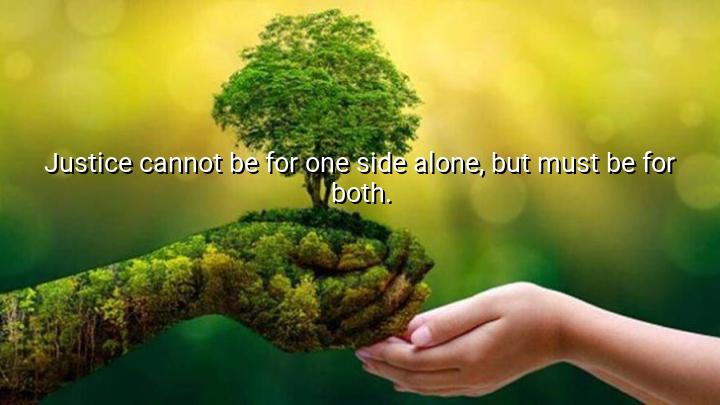




In this quote, Eleanor Roosevelt emphasizes the fundamental principle of justice as being impartial and inclusive. She states that justice cannot favor only one side in a conflict or issue but must be extended to both parties involved. Roosevelt highlights that true justice requires fairness and balance, ensuring that the rights and interests of all individuals are considered, regardless of their position or viewpoint.
The quote reflects Roosevelt's strong belief in human rights and equality. Throughout her life, she was an advocate for social justice, fighting for the rights of marginalized groups and promoting fairness in society. She recognized that justice is not just a legal or political concept but a moral imperative that requires empathy and understanding for all sides of a situation.
Roosevelt's statement also calls attention to the dangers of bias or partiality in decision-making processes. When justice is skewed toward one group, it undermines the very essence of fairness and can perpetuate inequality. This message encourages a more holistic approach to justice, where all voices are heard and respected, and solutions are fair and just for everyone involved.
Ultimately, the quote is a reminder that justice is a universal value that must be applied equally and consistently to all individuals and groups. Eleanor Roosevelt's words call for fairness, understanding, and the need to address the needs of both sides in any conflict or issue to achieve true justice.

TTLe Triet Thuc
I find this quote both wise and complex. It’s easy to talk about fairness in theory, but in practice, one side often feels that justice means their story is prioritized. So how do we ensure both voices are honored without minimizing one’s pain? Especially in issues involving oppression or trauma, does treating both sides equally risk perpetuating injustice? Roosevelt's view invites a deeper dive into what justice really entails.
HSHOA SI
This quote challenges me to reflect on my own sense of justice. When I feel wronged, I tend to focus only on my side. But Roosevelt reminds us that fairness means taking the other person’s reality into account, even when it’s inconvenient or painful. Is it possible to practice that consistently in personal relationships or public policy? It’s hard—but maybe that’s where real transformation begins.
HHHai Hoang
Roosevelt’s statement feels especially relevant in our polarized world. Whether it's in politics, race relations, or international conflict, people often fight for justice as if it’s a prize to be claimed—not a principle to be shared. How can we create a culture that genuinely seeks fairness for all rather than vengeance or validation for one group? Maybe the first step is listening deeply, even when it’s uncomfortable.
Dd
I love the idealism in Roosevelt’s quote, but I wonder how it plays out in reality. Can justice really be balanced when emotions, pain, and personal interests are involved? Think about legal disputes or political conflicts—how often are both sides truly heard and respected? This makes me ask: are we more interested in winning arguments or actually achieving justice? And do we even recognize when we’re biased?
HPPham Hong Pha
This quote makes me think about how difficult true justice really is. We often believe we're being fair, but aren't most systems skewed by perspective, power, or bias? If justice must be for both sides, how do we uphold that in situations where one side has historically held more privilege or committed more harm? Is it justice to treat both sides equally, or does justice require equity instead of symmetry?