

Just as a cautious businessman avoids investing all his capital in one concern, so wisdom would probably admonish us also not to anticipate all our happiness from one quarter alone.
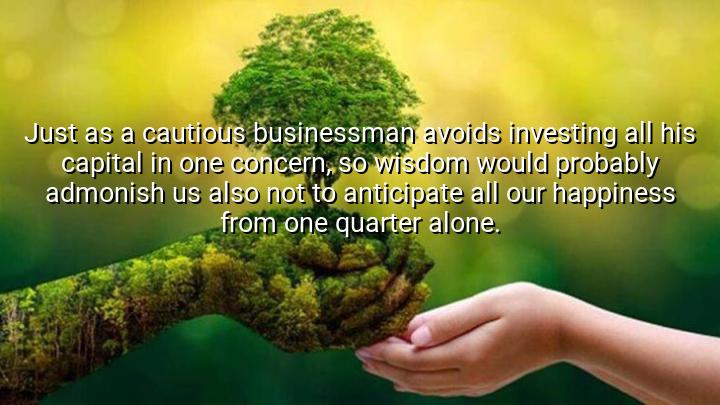




The quote "Just as a cautious businessman avoids investing all his capital in one concern, so wisdom would probably admonish us also not to anticipate all our happiness from one quarter alone." by Sigmund Freud uses an analogy to emphasize the importance of diversifying sources of happiness and not relying too heavily on one aspect of life for fulfillment. Freud compares the approach of a cautious businessman, who wisely spreads investments across multiple ventures to minimize risk, to the way people should approach their sources of joy and satisfaction. Relying on one source for happiness can lead to disappointment or instability if that source fails or is lost.
Freud's words suggest that wisdom lies in finding balance and ensuring that we cultivate multiple sources of fulfillment, whether it be from relationships, work, hobbies, or other personal pursuits. Just as a business might struggle if its success depends on one investment, a person who stakes all their happiness in one area might find themselves vulnerable to life’s inevitable challenges or changes. Happiness, Freud implies, should be distributed across different aspects of life to ensure a more resilient and stable sense of well-being.
The quote also highlights the human tendency to focus on a singular goal or relationship as the key to happiness. Freud’s advice is a reminder that true fulfillment comes from variety and multiplicity, where one does not place all emotional or psychological investments into a single part of their life. This also ties into his broader ideas about the unconscious mind and the complex motivations that influence our pursuit of happiness and satisfaction.
The origin of this quote lies in Sigmund Freud, an Austrian neurologist and the founding figure of psychoanalysis. Freud’s work often dealt with the intricacies of human desire, pleasure, and conflict, and his observations on how people seek happiness reflect his understanding of the mind and its many layers. This quote represents his belief in the need for a balanced approach to life and emotional well-being, recognizing that true satisfaction comes from a well-rounded and varied set of pursuits.

VNVinh Nguyen
I appreciate the analogy to business, as it frames emotional wellbeing in a practical light. But does this comparison risk making happiness sound transactional or calculated rather than spontaneous? How might Freud’s suggestion influence how people approach love and friendships? Could this perspective encourage healthier emotional boundaries or might it lead to emotional detachment?
TTNgoc Tu Tran
This quote struck me with a sense of cautious realism. It seems to highlight the risk of depending too much on one area for all our joy. But could this caution also reflect a fear of vulnerability? How can one cultivate multiple sources of happiness without losing depth or authenticity in any single one? Is this idea more about balance or about self-protection?
BSnguyen ba song
I'm curious about the practical implications of this advice. In financial terms, diversification is clear-cut, but in emotional life, what would it mean to 'invest' wisely? Is Freud advocating for emotional resilience through variety, or is there a risk of spreading oneself too thin and ending up feeling disconnected? How do cultural differences impact this viewpoint on happiness and fulfillment?
HC05. Nguyen Hong Chau
This quote makes me wonder about the nature of happiness itself. If relying on multiple sources is wiser, does it mean that happiness is inherently fragile or temporary? Could it be that Freud is warning against unrealistic expectations rather than discouraging deep attachment? How might this idea apply to mental health—does diversifying our sources of joy protect us from despair during tough times?
DKDang khai
I find this perspective quite insightful, especially in today's world where people often put all their emotional eggs in one basket, whether in relationships or career goals. Do you think this approach suggests that spreading our sources of happiness could actually lead to a more stable and fulfilling life? Or might it imply a certain guardedness that prevents deep commitment? How do we balance diversification of happiness with genuine passion or focus?