

It's an interesting combination: Having a great fear of being alone, and having a desperate need for solitude and the solitary experience. That's always been a tug of war for me.
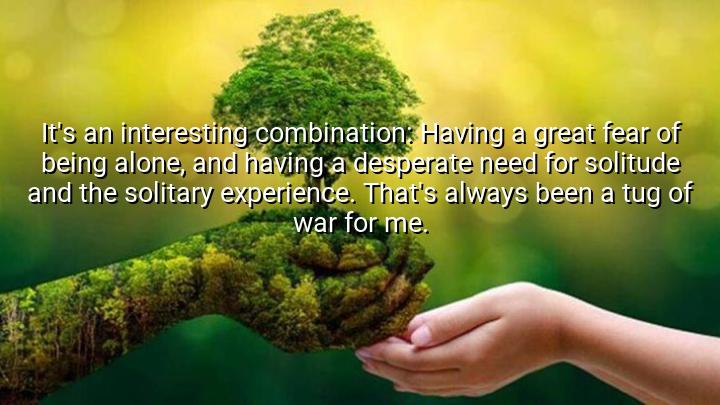




The quote "It's an interesting combination: Having a great fear of being alone, and having a desperate need for solitude and the solitary experience. That's always been a tug of war for me" by Jodie Foster captures the emotional complexity of craving solitude while simultaneously fearing loneliness. Foster describes an internal conflict—a deep desire to retreat into quiet, personal space for reflection or creativity, while also struggling with the emotional discomfort that aloneness can bring. This quote speaks to a universal tension between the need for connection and the need for privacy.
Jodie Foster, an acclaimed actress, director, and producer, is known not only for her award-winning work but also for her intensely private nature. In interviews, she has openly discussed her preference for a life away from the public eye, which contrasts with the visibility demanded by her career. This quote likely reflects her personal journey of balancing the emotional need for isolation with the very human fear of being cut off or unseen.
The phrase "tug of war" perfectly captures the push and pull many people feel between needing time to be with themselves and fearing what that solitude might reveal—such as insecurity, emptiness, or longing. Foster’s insight acknowledges that solitude can be both nourishing and unsettling, especially for those who are highly introspective or sensitive.
Ultimately, this quote is a powerful expression of emotional honesty. It reminds us that solitude and loneliness are not opposites, but often two sides of the same experience. Foster’s words invite us to embrace this internal tension with compassion, recognizing that it's possible to yearn for space while also needing connection—and that navigating that balance is a deeply personal and ongoing process.

KHNguyen Khanh Huyen
This quote hits me right in the middle of a conflict I’ve never been able to articulate. There's this strange comfort in solitude that I deeply crave, but then there’s also that panic when I feel disconnected. It makes me ask—how much of our struggle with being alone comes from within, and how much is shaped by how we’ve been taught to value togetherness? Can we redefine solitude in a way that feels safe?
UGUser Google
What stands out to me in this quote is how it captures the complexity of emotional needs. It’s not black and white. Wanting solitude doesn’t cancel out the fear of being alone, and that’s okay. But I wonder—can those two needs coexist peacefully, or do they always compete? Maybe the goal isn’t to solve the tug-of-war but to learn how to live with both desires pulling at once without tearing ourselves apart.
NLNguyen Loan
Foster's words really made me stop and reflect. I love my alone time, but I also hate the thought of being left out or forgotten. Is this contradiction rooted in personality, trauma, or something more universal? It feels like walking a tightrope—craving emotional freedom but also fearing emotional distance. How do we cultivate solitude without inviting loneliness, and what role does connection play in keeping that balance healthy?
YNYen Nhi
This quote feels like an emotional paradox I know all too well. It makes me curious: can we ever truly reconcile the need for solitude with the fear of aloneness? Or is the tension part of what makes us human—needing quiet to know ourselves but needing others to feel grounded? I wonder how people manage this tug-of-war without either side winning too much and creating imbalance.
HBHuy Beo
I deeply relate to this quote—it captures a conflict that’s hard to explain to others. How can we crave solitude yet fear loneliness at the same time? It makes me wonder if the key difference lies in control. Solitude is chosen, empowering; loneliness feels imposed. But what happens when those boundaries blur? Is it possible to enjoy being alone without slipping into isolation, or does the fear always linger just beneath the surface?