

It's a cliche, but although we're all different, we're also pretty similar. Rather than caring about the problems that affect us alone, maybe we should start caring about the problems that we've created and start reversing them.
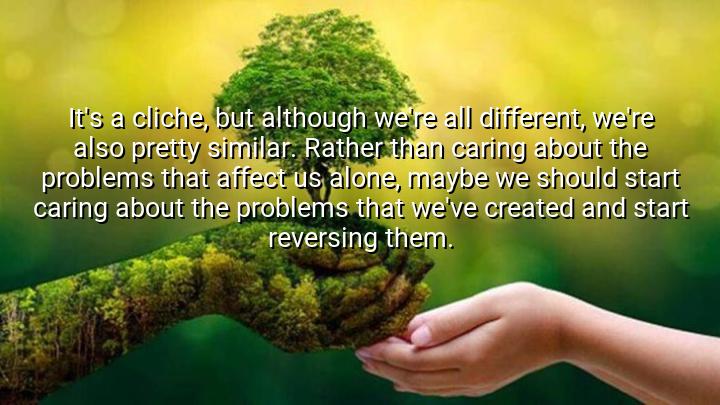




In this quote, Declan McKenna, a British singer-songwriter, reflects on the universal nature of human experience. He acknowledges that while we may all be different, we are also fundamentally similar in many ways. McKenna suggests that instead of focusing solely on the issues that affect us individually, we should begin to take responsibility for the problems that have been created collectively, particularly those stemming from our own actions. This calls for a shift from self-centeredness to a more global perspective, where the focus is on solving problems that impact society as a whole.
McKenna’s statement encourages a sense of shared responsibility for the issues we face, such as environmental degradation, inequality, and other social challenges. By recognizing that our collective actions contribute to larger global problems, we can begin to shift our mindset from individual concerns to collective action. This perspective invites people to care about the bigger picture and to work together to address the issues that affect not just one person or one group, but everyone.
The origin of this quote likely stems from McKenna’s own experiences and the themes present in his music. Known for addressing issues such as social justice, environmentalism, and youth activism, McKenna often encourages his audience to think critically about the world around them and their role in shaping it. This quote reflects his belief in the power of collective responsibility and the need for individuals to come together to reverse the damage done by past actions.
In essence, McKenna’s quote calls for a shift in focus—from individual problems to the broader, shared challenges we all face. By acknowledging our interconnectedness and collective responsibility, he advocates for reversing the damage and taking action to create a more equitable and sustainable future for everyone. It is a call to prioritize the common good over individual concerns, urging us to work together toward a better world.

QDNhu Quynh Dang
The idea that caring about collective problems can lead to reversing them is inspiring. But how do we overcome apathy and cynicism that often accompany large-scale issues? What role do leaders, communities, and individuals play in sustaining momentum for change? It’s a complex but vital conversation for our future.
NVNgoc Van
This quote challenges us to reflect on accountability. What does it mean to acknowledge that we’ve created problems, and how do we balance guilt with constructive action? Can focusing on shared solutions foster unity instead of division? It’s a powerful reminder that change begins with awareness and collective effort.
MHnguyen ngoc mai huyen
McKenna’s words make me think about the role of youth in shaping a more inclusive future. Are younger generations more likely to embrace this interconnected view? How can their energy and idealism be harnessed to drive systemic change? It seems essential to empower and listen to those who care about collective well-being.
TDThuy Duong
Reading this, I’m reminded of how easy it is to focus narrowly on our own struggles. How do you think we can cultivate a sense of global citizenship without minimizing individual experiences? Could grassroots movements or international cooperation be the key to reversing problems we’ve created? It’s a hopeful yet daunting task.
TTTran T
This quote highlights the paradox of our differences and similarities. How can recognizing shared challenges help bridge cultural, political, or social divides? Is it enough to care about problems collectively, or must we also change behaviors and systems? I’m curious about how education and media can foster this mindset of shared responsibility.