

It seems that when you have cancer you are a brave battler against the disease, but when you have Alzheimer's you are an old fart. That's how people see you. It makes you feel quite alone.
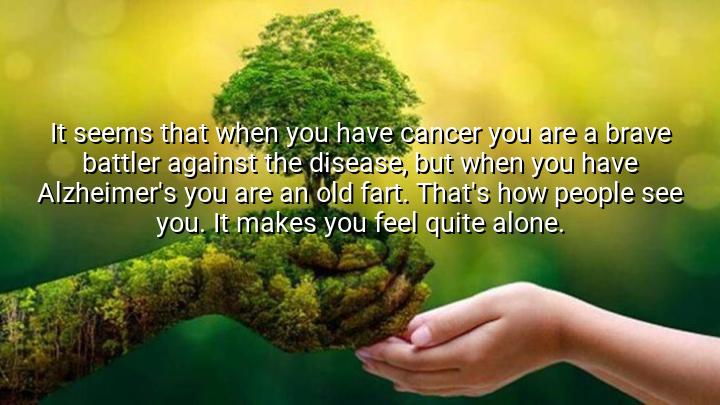




The quote "It seems that when you have cancer you are a brave battler against the disease, but when you have Alzheimer's you are an old fart. That's how people see you. It makes you feel quite alone." by Terry Pratchett reflects the societal attitudes toward disease and aging, particularly in the context of Alzheimer's disease. Pratchett, a beloved British author best known for his Discworld series, speaks from his personal experience of living with Alzheimer's, highlighting the stigma and misunderstanding surrounding the condition. While individuals battling other serious diseases, like cancer, are often admired for their courage and resilience, those with Alzheimer's are frequently dismissed and reduced to the stereotype of being elderly or frail.
Pratchett’s observation points to a cultural discrepancy in how different diseases are perceived. People with cancer are often seen as fighters or heroes, while those with Alzheimer's are ignored or disrespected, their condition trivialized as a mere sign of aging rather than a debilitating disease. This difference in how patients are viewed can contribute to feelings of alienation and loneliness for those living with Alzheimer's, as Pratchett expresses in his own experience of being made to feel isolated and misunderstood.
The phrase "it makes you feel quite alone" captures the emotional toll of Alzheimer's not just on the individual, but on their sense of identity. The condition gradually erodes memory and cognitive function, and the lack of empathy from others can deepen the sense of isolation. Pratchett’s quote reflects how those affected by Alzheimer's can feel as though they are no longer seen as active, valuable members of society but are instead reduced to their disease, often leading to emotional distress.
Ultimately, Pratchett’s words shine a light on the misrepresentation and neglect of those suffering from Alzheimer's disease. His insight calls for greater awareness, compassion, and understanding of Alzheimer's and other forms of dementia, encouraging society to see those affected not as invisible or insignificant, but as individuals deserving of respect and dignity, irrespective of their condition.

Llethibichhue
I wonder about the impact of public figures like Terry Pratchett openly discussing their Alzheimer’s diagnosis. Does such visibility help break down stigma or reinforce stereotypes? How important is it for society to hear directly from people living with Alzheimer’s to foster understanding? Could this lead to more funding, research, and better support systems?
GNGiang Nguyen
Emotionally, this quote is heartbreaking because it reveals a gap in human connection. How do feelings of invisibility or dismissal affect the mental health of those with Alzheimer’s? Can storytelling, advocacy, or art play a role in bridging this gap? How might personal experiences like Pratchett’s inspire more inclusive attitudes toward all diseases?
Hhelohaha
This highlights a broader issue about how society values certain illnesses over others. Do visible symptoms like those in cancer elicit more empathy than cognitive decline, which is less understood? How can we challenge ageism and misconceptions that contribute to feelings of loneliness among Alzheimer’s patients? What steps can healthcare providers take to address these disparities?
DDln
I’m struck by the idea that illness narratives shape how patients are treated and perceived. Why is the ‘battle’ metaphor so powerful for cancer but seemingly absent for Alzheimer’s? Could changing the language around Alzheimer’s help patients feel less isolated and more valued? What role do caregivers and communities have in reshaping these narratives?
BNphan thi bao nhi
This quote makes me reflect on the emotional loneliness people with Alzheimer’s might experience. Is the lack of societal sympathy due to misunderstanding or fear of the disease? How can we better educate the public to reduce stigma and provide more compassionate care? It seems crucial to reframe Alzheimer’s not as a loss of identity but as a condition deserving dignity.