

It is not the soul alone that should be healthy; if the mind is healthy in a healthy body, all will be healthy and much better prepared to give God greater service.
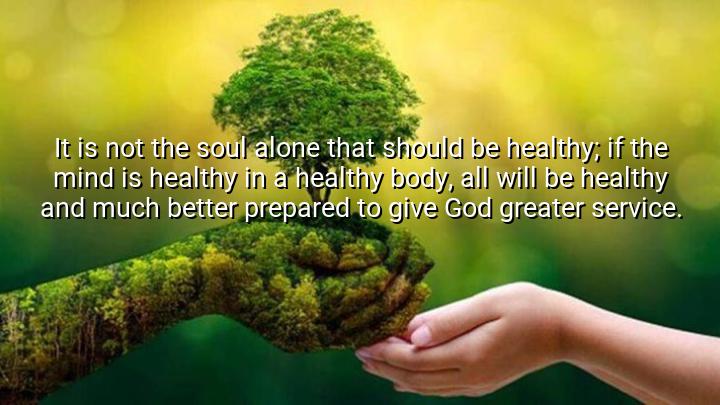




In this quote, Saint Ignatius of Loyola, a Catholic priest and founder of the Society of Jesus (Jesuits), emphasizes the holistic connection between the soul, mind, and body. He suggests that health is not just a matter of spiritual well-being or the condition of the soul, but that true well-being requires the balance of mind and body as well. For Saint Ignatius, a healthy body supports a healthy mind, and together, they enable a person to fully serve God and contribute to the world in a meaningful way.
Saint Ignatius underscores the idea that the mind and body are not separate from the soul; they are interconnected and essential for overall well-being. A healthy body provides the strength and vitality necessary to engage in spiritual and intellectual pursuits. Similarly, a healthy mind enhances the ability to understand, reason, and make decisions that align with spiritual goals. This philosophy promotes the integration of physical, mental, and spiritual health as essential components of a fulfilling life.
The quote also highlights the role of service to God as the ultimate purpose of maintaining a balanced, healthy life. By caring for the body, the mind, and the soul, individuals are better equipped to dedicate themselves to spiritual service and contribute to their communities. Saint Ignatius believed that a person who is physically strong and mentally sound is in a better position to live out their spiritual calling and contribute to the greater good.
Ultimately, Saint Ignatius’ quote reflects his belief in the holistic nature of human existence, where spiritual, mental, and physical health are intertwined. His emphasis on maintaining a healthy body and mind as a means to serve God underscores the Jesuit ideal of finding balance and purpose in all aspects of life. This approach encourages individuals to care for their entire being in order to more fully fulfill their spiritual and worldly responsibilities.

TNPham Thanh Nam
This quote makes me wonder how service to God—or even to others—is impacted by our state of being. Can someone who is physically weak but mentally strong still offer deep service? Or is the synergy between all three—body, mind, and soul—essential for maximum impact? I'm curious whether the quote values the combination over the individual elements, or if one can compensate for the others in practice.
TPThen Pham
Is it possible that modern interpretations of this idea could become too perfectionist? The notion that we must maintain full health in every dimension to truly serve might pressure people into unrealistic expectations. What happens when someone falls short? Does the drive for ‘ideal service’ ever hinder people from accepting grace in their limitations?
QDPhung Quoc Dat
This reminds me of how easily people separate the spiritual from the physical, as if prayer and exercise, or meditation and eating well, don't belong together. Do you think society has created false boundaries between faith and health? I'd love to hear how others blend spiritual practice with daily physical and mental self-care—especially in fast-paced or secular environments.
MNMinh Nguyen
While I agree with the idea of harmony between body, mind, and soul, I wonder about those who live with chronic illness or mental health struggles. Does this quote unintentionally exclude them from being seen as fully prepared to serve a higher purpose? I’m concerned that it could be interpreted in a way that ties worthiness too closely to physical or mental ‘fitness.’
CDThanh Cong Duong
I'm intrigued by the implication that caring for one’s physical and mental health isn’t just self-serving, but actually part of one’s service to God. That reframes wellness as something sacred, not just personal. Does this mean we have a moral or spiritual obligation to care for ourselves? I’d love to know how different faith traditions interpret this balance between the physical and the spiritual.