

It is a good idea to be alone in a garden at dawn or dark so that all its shy presences may haunt you and possess you in a reverie of suspended thought.
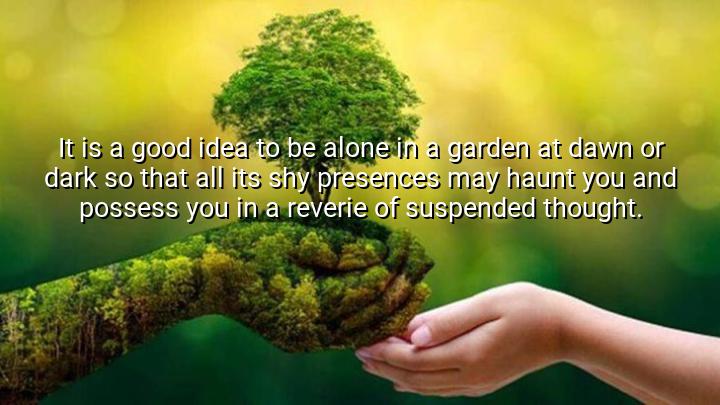




In this quote, James Douglas suggests that being alone in a garden at dawn or dark creates the ideal setting for personal reflection and a connection with nature. He emphasizes the importance of solitude in these tranquil moments, allowing one to experience the subtle, often overlooked aspects of the natural world. The garden, with its shy presences, symbolizes the quiet, invisible elements of life—whether they are feelings, memories, or spiritual experiences—that can only be perceived in moments of stillness and introspection.
The idea of being "haunted" by the garden’s presences refers to how nature, in its solitude and quiet, can evoke deep emotions and reflections. In these quiet moments, when one is alone and free from distractions, the mind becomes open and receptive to the more delicate aspects of the world around us. The phrase "haunt you and possess you" suggests that nature, in its subtle beauty, can deeply affect and influence the individual, drawing them into a contemplative state or reverie.
Douglas also highlights the concept of suspended thought, which suggests a mental state where the individual is not actively thinking or analyzing, but instead, allowing their mind to drift and absorb the peaceful atmosphere. In this suspended state, the mind is open to deeper connections with the world, allowing one to feel the emotional and spiritual significance of their surroundings without the need for active processing or judgment.
Ultimately, this quote encourages the reader to seek out moments of solitude in nature, where they can disconnect from the hustle of everyday life and immerse themselves in a reflective, almost meditative state. It suggests that in the quiet of a garden at dawn or dusk, one can experience a profound connection with nature and themselves, finding peace and insight in the stillness.

TPTrinh Phuong
This quote feels like an invitation to escape the noise of everyday life and enter a space where thought dissolves. The idea of being haunted in a gentle way by the garden’s 'shy presences' is so evocative. But I’m curious—can this kind of experience help us connect with parts of ourselves we normally ignore? Is reverie just relaxation, or is it a kind of unconscious healing?
UGUser Google
I love how this quote elevates solitude in nature to something almost mystical. But I wonder—can this type of deep communion with the natural world happen in a city park, or is it only possible in a more secluded setting? Do the surroundings need to be wild and untouched, or is it more about the mindset we bring into the moment?
DDDinh Duc
Douglas’s quote speaks to something I’ve felt but never had words for—the way nature can gently overwhelm you when you give it your full attention. It makes me think about the spiritual aspects of solitude in natural spaces. Are these moments just peaceful, or are they also transformative in ways we don’t fully understand? Maybe nature is less a background and more a participant in our inner lives.
HNHoan Nguyen
There’s a poetic eeriness to this idea that a garden can ‘possess’ you. I’m intrigued by the notion that nature isn't just observed but has a presence that interacts with us when we’re still enough to notice. But what if someone doesn't find peace in solitude? Can these moments become unsettling instead of calming? I’m curious how our inner state influences the way we experience such quiet spaces.
QQuyen
I find this quote hauntingly beautiful. It reminds me how nature has a way of revealing itself when we slow down and become silent. But it also makes me wonder—how often do we allow ourselves to be truly alone in nature without distraction? In a world where we’re constantly stimulated, how do we rediscover that capacity for ‘suspended thought’ Douglas speaks of?