

It doesn't matter about money; having it, not having it. Or having clothes, or not having them. You're still left alone with yourself in the end.
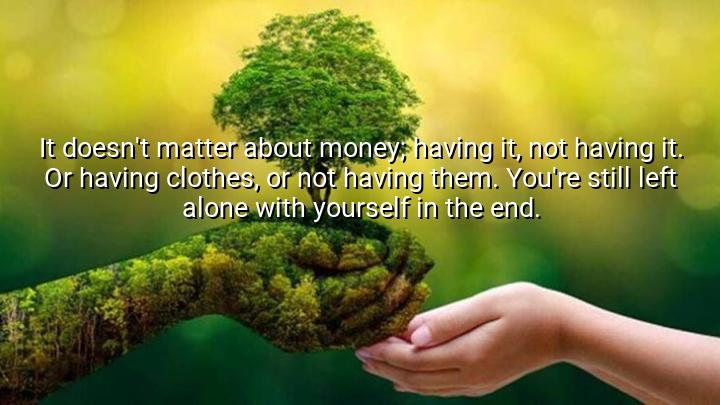




In this quote, Billy Idol reflects on the idea that material possessions, such as money and clothes, ultimately hold little value when it comes to true fulfillment or self-understanding. He suggests that whether a person has these material things or not, they are still left to face their own inner reality, being "left alone with yourself in the end." This implies that external circumstances, such as wealth or status, cannot provide lasting happiness or shield a person from confronting their own identity and emotions.
Idol emphasizes that the pursuit of money and material possessions can be distracting, but they do not address the deeper human need for self-awareness and emotional connection. Having it or not having it does not alter the fundamental truth that individuals must ultimately come to terms with themselves. This suggests that personal fulfillment and peace are not found in external achievements but in the acceptance and understanding of one's own nature.
The quote also speaks to the transient nature of materialism. Regardless of whether a person possesses clothes or other symbols of status, they are still left with their own thoughts, feelings, and existential questions. The idea is that material wealth and possessions provide only temporary satisfaction and cannot replace the deeper journey of self-reflection and emotional connection that every individual must face alone.
Ultimately, Idol's quote highlights the importance of focusing on internal growth and self-acceptance rather than relying on material success to define one's worth or happiness. It serves as a reminder that no matter how much we accumulate externally, we cannot escape the essential need to understand and reconcile with ourselves.

NLLuu Ngoc Lan
Billy Idol’s words strip life down to its essence—what remains when the external is gone? It makes me question whether I’m building a life based on distractions or depth. If nothing can protect us from ourselves in the end, shouldn’t self-awareness and self-compassion be considered forms of wealth too? I think it’s easy to forget that personal peace isn’t a luxury—it’s a necessity.
TTQuynh Tran Thi
I find this quote both comforting and sobering. On one hand, it reminds me not to overvalue material things. On the other, it confronts me with the reality that self-reflection is unavoidable. What happens when the noise quiets down and it’s just you and your thoughts? Does this mean our greatest responsibility is to cultivate a self that we can live with, even in solitude?
TPThao Phuong
This makes me think about how people often chase success thinking it will insulate them from loneliness or insecurity. But if you're always running from yourself, nothing external can save you. I wonder—how many of us are truly comfortable in our own company, stripped of roles and possessions? Maybe that's the real work—building a relationship with yourself that isn’t dependent on validation or stuff.
TALe Thuy An
Idol’s quote really hits on the existential truth that all the noise and clutter of modern life fades away in quiet moments. But it raises a question: how do we actually build a self that we’re content to be alone with? In a culture that rewards appearance and achievement, are we neglecting the inner self? What does it even mean to be at peace with yourself, especially in today’s world?
PTthanh Phung Tien
This quote feels like a raw reminder that no matter what we accumulate—wealth, fame, material comfort—we ultimately have to live with ourselves. It makes me think: how often do we use external things to distract from internal emptiness? If none of that shields us from facing who we are at the core, shouldn’t self-understanding be a bigger priority in life? Maybe solitude isn't something to avoid, but to prepare for.