

Inside myself is a place where I live all alone and that is where I renew my springs that never dry up.
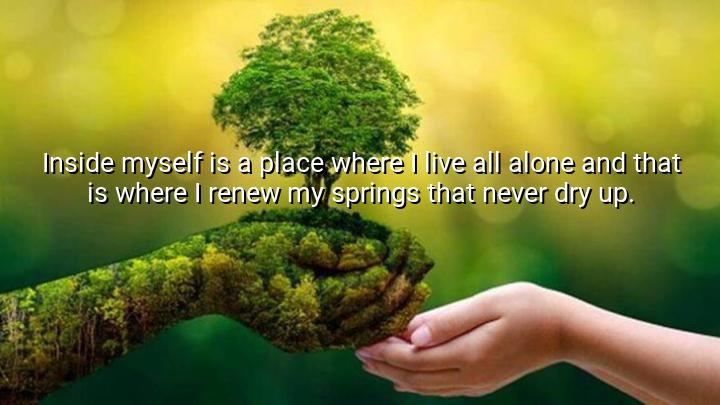




The quote "Inside myself is a place where I live all alone and that is where I renew my springs that never dry up" by Pearl S. Buck speaks to the importance of inner solitude as a source of strength, renewal, and self-understanding. Rather than fearing aloneness, Buck embraces it as a deeply nourishing space where she can return to her core self and find peace and inspiration. It suggests that within each person lies a quiet, untouched place that holds endless emotional and spiritual resources.
Pearl S. Buck, a Nobel Prize-winning author and humanitarian, often wrote about identity, resilience, and the human condition, drawing from her experiences growing up in China and later working in the U.S. This quote reflects her understanding of inner life—that personal growth and creativity come not only from interaction with the world but from periods of introspection and solitude.
The imagery of “springs that never dry up” evokes a sense of endless vitality and renewal that resides within. It implies that by returning to this internal place, one can constantly replenish their energy, hope, and clarity, no matter what challenges the external world brings. This kind of solitude is not empty or lonely—it is restorative, rich, and full of life.
Ultimately, Buck’s words remind us of the importance of cultivating our inner world. In the midst of a noisy, demanding society, having a personal space for reflection and reconnection can be essential to our well-being. It's a gentle encouragement to turn inward and trust that within ourselves lies a source of strength that never fades.

TLtramm Lann
This line feels like poetry and truth all in one. The imagery of a spring that never dries up suggests endless resilience. But is that kind of emotional reservoir innate, or something we have to nurture over time? I wonder how many people are afraid to be alone long enough to find that space within themselves—mistaking stillness for emptiness instead of abundance.
PHhien phu hien
I love how this quote affirms the idea that true strength and replenishment come from within. But it also makes me think—can that inner spring ever dry up if we’re too disconnected from ourselves for too long? How do we maintain that source of strength when life gets overwhelming or noisy? Is solitude alone enough, or do we need deliberate reflection to tap into it?
TTLe Thanh Toan
There’s something deeply comforting about this idea. It reframes being alone as an act of self-renewal rather than loneliness. But I do wonder—what happens if someone hasn’t discovered that place yet? Can we live our whole lives unaware of that inner sanctuary? And if so, how do we help others uncover it in a world that rarely encourages quiet self-reflection?
PTNguyen Phuong Thanh
Pearl S. Buck’s insight here feels incredibly grounded and wise. It makes me question how often I actually spend time in that internal space of restoration, versus distracting myself with noise. What does it take to connect with that inner spring? Is it solitude, meditation, creativity—or just slowing down long enough to listen to yourself?
PNPham Tan Phuc Nguyen
This quote is so nourishing to read—it makes solitude sound not like a retreat, but a wellspring. I wonder, how many of us actually have a place like that inside ourselves? And if we don’t, can it be cultivated? It seems to suggest that true renewal doesn’t come from external validation, but from inner quiet. Do you think everyone has the potential to find that inner space, or is it a learned practice?