

Inductive reason, which alone makes man master of his environment, is an achievement; and when once born it must be reinforced by inhibiting the growth of other modes of knowledge.
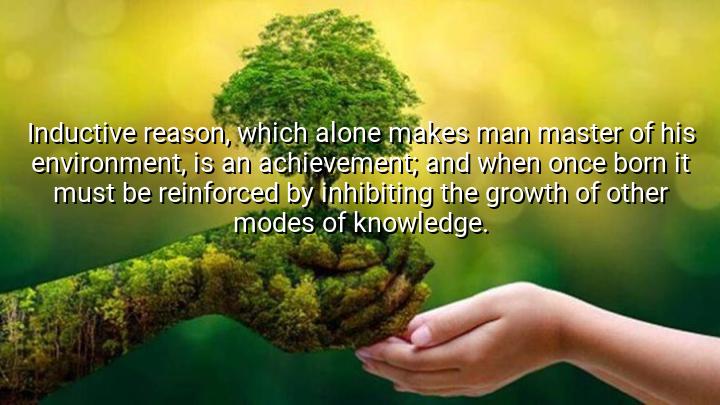




In this quote, Muhammad Iqbal, a renowned philosopher and poet, discusses the concept of inductive reasoning as a key factor in humanity's ability to master its environment. Inductive reasoning, the process of drawing general conclusions from specific observations, is described as an achievement because it allows humans to understand and control the world around them. Iqbal suggests that the development of this mode of thinking is essential for progress, as it enables individuals to make sense of their surroundings and act in ways that shape their environment.
Iqbal further argues that once inductive reasoning is developed, it must be actively reinforced by limiting the growth of other types of knowledge. This implies that while reasoning is important, it is crucial to focus on cultivating it in order to avoid the influence of other, less objective or reliable forms of knowledge. Iqbal seems to advocate for a disciplined approach to thinking, where critical reasoning takes precedence over instinctual or traditional methods of understanding, which might hinder the ability to adapt and innovate.
The origin of this quote lies in Iqbal’s philosophy, which blends elements of Islamic thought with modern Western intellectual traditions. Iqbal believed in the importance of self-development and the active role of human intellect in shaping both individual and societal progress. His works often emphasize the idea that the mind must be trained to think critically, and that spirituality and reasoning should work together to elevate humanity.
In essence, Iqbal’s quote highlights the importance of inductive reasoning as a tool for personal and societal mastery. He suggests that once this mode of reasoning is developed, it must be cultivated and protected from other, potentially less effective ways of understanding the world. The idea is that focused, critical thought is crucial to human progress, and it must be carefully nurtured to avoid being overshadowed by less structured forms of knowledge.

Ttongvinh
Reading this, I’m intrigued by the idea that mastery through inductive reasoning requires sidelining other knowledge types. Could this be why some scientific advancements feel disconnected from human values or meaning? How do you think we can reconcile the strength of inductive reasoning with the richness of other epistemologies to create a more balanced worldview?
HTHai Truong
This quote highlights the achievement of inductive reason but also hints at its exclusivity. Do you think it’s possible to master our environment while honoring multiple ways of knowing? How can societies encourage the growth of diverse knowledge forms without diluting scientific rigor? It’s a complex issue with implications for innovation and cultural preservation.
TGnguyen dang truong giang
Iqbal’s idea challenges us to think about how knowledge systems compete or complement each other. Could inhibiting other modes of knowledge lead to a narrow worldview? How might this affect creativity, ethics, or spirituality? It seems important to explore how education and culture shape the dominance of certain ways of knowing over others.
KTNguyen Kieu Trinh
This quote makes me wonder if the elevation of inductive reasoning as mastery comes at a cost. What might be lost when other modes of knowledge are inhibited? Does this suggest a tension between scientific progress and more traditional or experiential wisdom? It’s worth discussing whether true mastery requires integrating diverse ways of understanding rather than suppressing them.
HTHO HUONG THAO
Muhammad Iqbal’s statement raises an interesting point about the dominance of inductive reasoning in human progress. But does reinforcing this mode necessarily mean suppressing other forms of knowledge, like intuition or spiritual insight? Could valuing one mode over others limit a more holistic understanding of our environment? I’m curious how different cultures balance logical reasoning with other ways of knowing.