

In truth, I have done nothing alone. God has called me and has been my pilot. The Holy Spirit has been my comforter, my guide, and my power source.
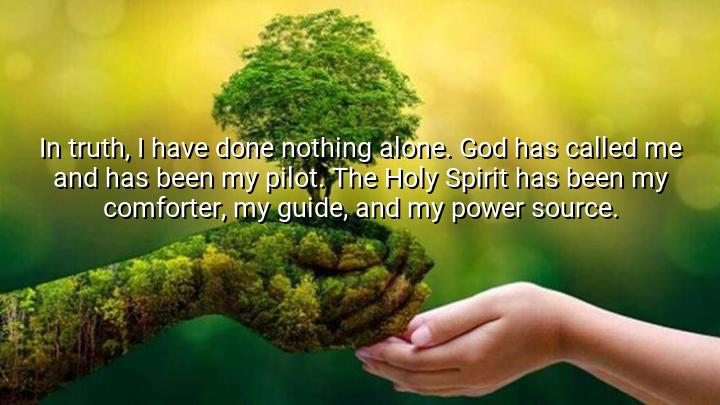




The quote by Reinhard Bonnke highlights the profound sense of humility and reliance on divine guidance throughout his life and ministry. By stating, "In truth, I have done nothing alone," Bonnke emphasizes that his achievements and actions were not by his own strength or wisdom, but through the power and presence of God. This reflects a core principle in Christian faith—that believers are never truly alone in their endeavors when they are guided by divine forces.
The phrase, "God has called me and has been my pilot," suggests that God is the ultimate leader and decision-maker in Bonnke's life, steering him through the challenges and responsibilities he faced. The metaphor of a pilot implies a sense of direction and purpose that Bonnke attributed to his faith. It reinforces the idea that his path was charted according to a higher calling rather than personal ambition.
Moreover, Bonnke acknowledges the Holy Spirit as his constant companion, referring to the Spirit as his comforter, guide, and power source. In Christian theology, the Holy Spirit is often described as the presence of God within believers, providing them with strength, wisdom, and emotional support. Bonnke’s words express his deep belief in the Spirit's work in empowering and guiding him throughout his life.
In sum, this quote encapsulates a life lived in total submission to God's will, recognizing that all achievements and actions are done through His power and guidance. The imagery of the pilot and comforter evokes a sense of divine partnership, where human limitations are overcome by God's grace and strength.

TDDuc Tran Dinh
Bonnke’s testimony here speaks volumes about the depth of his faith. But I can’t help but ask—can someone live out a purpose-driven life without being explicitly conscious of divine guidance? What about people who do good, help others, and live ethically but don’t claim a spiritual source? Does their work carry less weight in Bonnke’s worldview, or is there space for many paths to meaning?
NLNhat Le
This quote offers a comforting sense of spiritual partnership. But I imagine it might raise questions for people who feel like they’ve tried to follow God and still faced setbacks. If someone doesn’t experience the Holy Spirit as a ‘comforter’ or ‘power source,’ does that mean they’ve failed in faith—or is there another explanation? I’d like to explore how Bonnke might counsel someone in that situation.
H712 Phan Thi Ngoc Ha 7TC7
There’s something beautiful and almost poetic in how Bonnke credits every step of his journey to divine companionship. Still, I wonder—does this belief in divine leading take away from personal responsibility? Or does it actually deepen it, since someone who feels led by God might hold themselves to even higher standards? I’d love to hear how he balanced faith with personal accountability.
TTuyen
I’m curious—how does someone know for sure that it’s the Holy Spirit guiding them and not just their own intuition? Bonnke speaks with such certainty, but spiritual discernment isn’t always that clear for everyone. What advice would he give to someone who desperately wants that kind of relationship with God but feels spiritually dry or unsure about hearing divine guidance?
NHNguyen Thi Ngoc Hao
This quote really challenges the modern idea of individual achievement. In a world that praises self-made success, Bonnke’s words are a reminder that some people view their journey as spiritually co-authored. But what does it look like in daily life to live as though God is the pilot? Does it mean surrendering control, or being more mindful of each step as part of a larger, divinely inspired path?