

In today's interdependent world, a threat to one becomes a menace to all. And no state can defeat these challenges and threats alone.
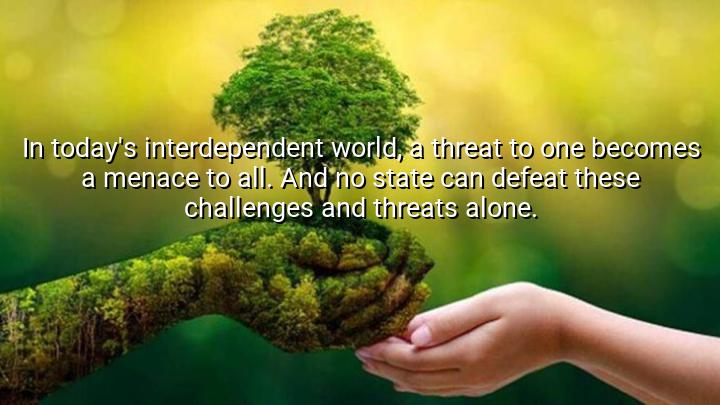




In this quote, Michelle Bachelet, the former President of Chile and United Nations High Commissioner for Human Rights, emphasizes the interdependence of nations in the modern world. She argues that in today’s globalized society, the challenges faced by one country, whether they be political, economic, or environmental, can have far-reaching effects on others. A threat to one country, such as a conflict or crisis, can quickly become a menace to all, underscoring the importance of international cooperation in addressing global issues.
Bachelet’s statement highlights the idea that no state can confront the complex challenges of the 21st century alone. Issues like climate change, pandemics, and terrorism are global in nature and require collective action to effectively manage. The interconnections between countries—through trade, technology, and communication—mean that the problems of one nation can quickly spread, impacting others. Bachelet advocates for a cooperative approach where countries work together to address these universal challenges.
The origin of this quote is rooted in Bachelet's career in international diplomacy and human rights. Throughout her time as both a national leader and a UN official, she has been deeply involved in discussions about global cooperation and the shared responsibility nations have to one another. Her views reflect her understanding of the complex, interconnected world, where isolationism or unilateral actions are increasingly ineffective in solving major global problems.
In essence, Bachelet’s quote stresses the necessity of collaboration and solidarity in dealing with contemporary threats. It serves as a reminder that in an interconnected world, the actions of one country can influence the stability and safety of the entire global community, and no nation can afford to tackle these challenges alone.

Hharlyn
Reading this makes me think about the role of non-state actors like NGOs and multinational corporations in addressing global threats. How do they fit into the picture alongside states? Can their involvement enhance or complicate coordinated responses? It seems that a multi-layered approach is needed to tackle such interconnected challenges effectively.
6I6a4 izabelle
This quote emphasizes vulnerability and shared fate, but how do cultural differences and historical conflicts complicate collaboration? Are there ways to build trust and mutual understanding that can transcend these obstacles? I’d be interested in examples where diverse nations have found common ground despite deep-seated tensions.
NNhu
Bachelet’s perspective seems especially relevant in the context of rising nationalism and isolationism. How do these political trends affect the ability to respond collectively to threats? Can global challenges compel countries to put aside differences temporarily, or do they deepen divisions? It’s a complex tension between national priorities and global responsibility.
GDGold D.dragon
I’m curious about the practical implications of this idea. How can smaller or less powerful states contribute meaningfully to global security when major powers dominate? Does this interdependence create opportunities for cooperation or exacerbate inequalities? The quote invites discussion on how global governance structures can be made more inclusive and effective.
AVNgoc Quynh Anh Vo
This statement makes me reflect on how interconnected threats like climate change, pandemics, and terrorism truly are. How can nations balance their sovereignty with the need for collaboration? Are there examples where countries successfully overcame these challenges by working together? It would be interesting to explore models of effective multilateral responses in the face of global threats.