

In solitude the mind gains strength and learns to lean upon itself.
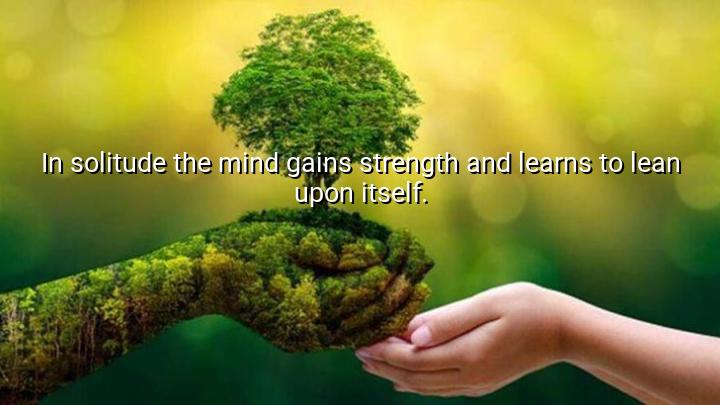




The quote "In solitude the mind gains strength and learns to lean upon itself" by Laurence Sterne emphasizes the powerful and transformative role of solitude in developing mental resilience and self-reliance. Sterne suggests that when we are alone, free from distractions and external influences, the mind is forced to turn inward. In doing so, it becomes stronger, more focused, and better able to stand independently without constant validation or support from others.
Laurence Sterne was an 18th-century Anglo-Irish novelist and clergyman, best known for his unconventional and deeply introspective novel The Life and Opinions of Tristram Shandy, Gentleman. Much of his work explores themes of individuality, reflection, and the complexity of human thought. This quote reflects his understanding of solitude not as loneliness, but as a vital condition for personal growth and mental clarity.
By learning to “lean upon itself,” the mind becomes more self-sufficient. In the absence of constant social input or distraction, one is compelled to face their own thoughts, emotions, and challenges. This inward journey fosters inner strength, critical thinking, and emotional maturity. It’s in solitude that many people discover their true values, make difficult decisions, or come up with creative insights.
Ultimately, Sterne’s quote celebrates solitude as an essential part of becoming a strong, independent individual. It is a reminder that withdrawing from the world temporarily is not weakness—it is an opportunity to cultivate the wisdom, stability, and confidence that come from depending on one’s own inner resources.

NHDuc nguyen huu
I love how this frames solitude as a developmental space rather than something to fear. But I can’t help but ask: is this growth accessible to everyone, or does it require a certain level of mental stability first? For those with anxiety or trauma, solitude might feel unsafe. How do we support people in finding strength in solitude without pushing them into harmful psychological territory? It feels like a delicate but important line.
HGNguyen Thi Huong Giang
This quote speaks volumes about self-discovery. I’ve found that solitude often reveals what distractions cover up—strengths, fears, even values. But I wonder, how long does it take for the mind to 'gain strength'? Can short moments of solitude offer the same growth as long periods, like retreats or sabbaticals? It raises questions about how much time we actually need to become truly self-sufficient and mentally fortified.
KHKhanh Hoang
Sterne’s quote resonates with me as someone who’s had to navigate change alone. There’s truth in how solitude forces you to listen to your thoughts without distractions. But I worry—can leaning too much on oneself become a burden? What if it prevents us from reaching out for help when we truly need it? How do we distinguish between empowering self-reliance and emotionally dangerous self-containment?
MHHoang Minh Hiep
This quote makes solitude sound like a training ground for inner strength, and I love that idea. But I also wonder—does this kind of strength come naturally in solitude, or does it require guidance, like journaling, meditation, or structured reflection? I'm curious whether solitude alone is enough for transformation, or if certain practices make it more meaningful. Otherwise, how do we keep it from becoming just empty stillness?
NTNguyet Tran
I really appreciate the empowering message here. It suggests that solitude isn't just about being alone—it's about building resilience. But I wonder, does every mind respond positively to solitude? For some, being alone might lead to anxiety or rumination. How do we ensure that solitude becomes a space for growth and not self-doubt? It feels like there's a balance between learning to rely on yourself and becoming emotionally isolated.