

In a world that is constantly changing, there is no one subject or set of subjects that will serve you for the foreseeable future, let alone for the rest of your life. The most important skill to acquire now is learning how to learn.
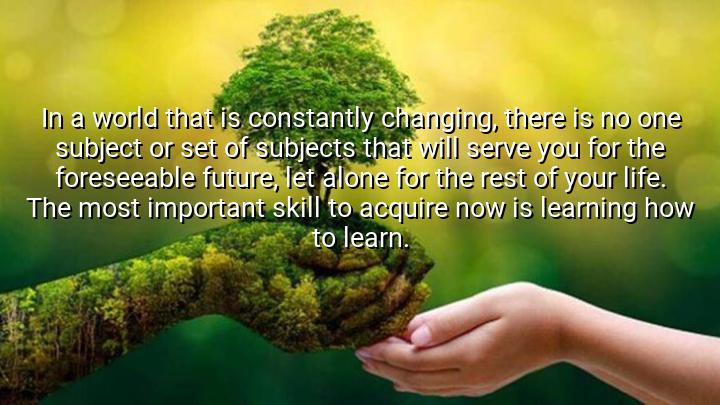




In this quote, John Naisbitt highlights the rapid pace of change in the modern world and the importance of adaptability in the face of constant transformation. He argues that there is no single subject or field of knowledge that will remain relevant or useful indefinitely. As the world evolves, new challenges and innovations arise, making it impossible to rely on a fixed set of skills or knowledge for the long term. Instead, Naisbitt suggests that the key to success is not mastering specific content but developing the skill of learning how to learn.
Naisbitt’s emphasis on learning how to learn reflects a shift in educational philosophy, where the focus is on developing critical thinking, problem-solving, and adaptability. By acquiring the ability to learn effectively, individuals are equipped to continuously update their skills and knowledge in response to new demands and circumstances. This approach prepares people to remain relevant and capable in a world where knowledge is continually changing and expanding.
The quote also underscores the idea that traditional methods of education, which focus on mastering specific subjects, may not be sufficient in the modern world. Instead, the ability to quickly acquire new information, evaluate it, and apply it to various contexts is more important than ever. Lifelong learning becomes an essential component of personal and professional growth, allowing individuals to thrive in an environment that is often unpredictable and fast-paced.
Ultimately, Naisbitt’s message is a call for individuals to embrace a mindset of continuous learning and to develop the skills necessary to adapt to the evolving world. In a time when technology and society are constantly changing, the ability to learn efficiently and stay open to new ideas is the most valuable skill anyone can cultivate.

HPNgoc Han Phung
I totally agree with this statement—it's why I’ve invested more in learning frameworks, not just facts. But sometimes I wonder, in a world flooded with information, is it more important to know how to learn, or how to unlearn? Old habits, outdated assumptions, even obsolete skills can get in the way. Should we be talking about unlearning just as much as we emphasize learning?
H915_22_Mai Chiem Hoa 9B
This quote makes me reflect on how much school failed to prepare me for this kind of flexibility. We were trained to master specific subjects, not to approach problems with a learning mindset. Do you think the current education reform movements are addressing this issue enough? Or are we still stuck in outdated models that don't reflect the reality of a fast-changing world?
DZQUAN DEP ZAI
I love the message here—it feels especially relevant for those of us who’ve had to pivot careers or pick up new skills later in life. But I’m curious: is this skill innate, or can it truly be cultivated at any age? I’ve seen people struggle deeply with learning new tools or concepts. What methods actually help develop the ability to learn effectively, especially when starting from scratch?
WDYou Will Die
I find this quote empowering but also kind of overwhelming. If no subject will serve us long-term, are we doomed to constantly chase new knowledge just to stay relevant? That sounds exhausting. How do we find balance between learning what’s needed now and preparing for an unknown future? I agree with the spirit of the message, but I worry that the pressure to 'keep up' could lead to burnout.
BDchan be du
This quote really hits home, especially in the age of AI and automation. But it makes me wonder—how exactly do we teach people to 'learn how to learn'? Is it about curiosity, critical thinking, adaptability? Traditional education systems still seem focused on rote memorization and fixed curricula. Shouldn’t we be restructuring the way we educate to prioritize mental agility over static knowledge? If so, what would that look like in practice?