

I'm not interested in dating. I like being with my own best friend, me. Certain women, particularly older women, cannot believe I like going to a social event by myself. But I do.
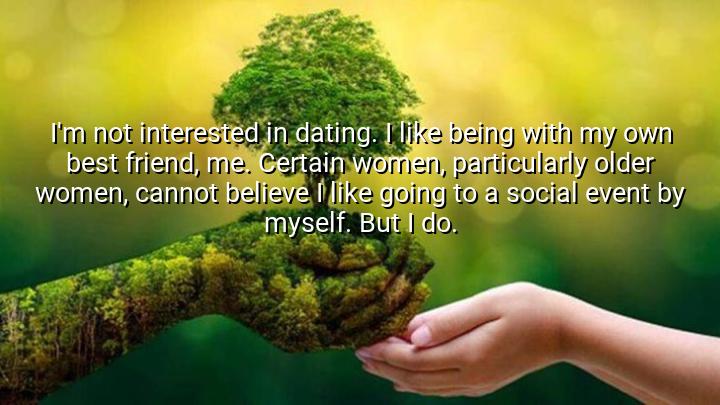




The quote "I'm not interested in dating. I like being with my own best friend, me. Certain women, particularly older women, cannot believe I like going to a social event by myself. But I do" by Gloria Allred emphasizes the value of self-reliance and self-acceptance. Allred, a prominent American attorney and women’s rights activist, expresses that she finds fulfillment and comfort in her own company, rejecting the social expectation that individuals, particularly women, should always be accompanied or involved in romantic relationships to be happy or socially successful.
Gloria Allred is known for her advocacy of women’s rights and social justice, often taking on high-profile cases involving issues such as equality and personal freedom. This quote reflects her broader personal philosophy of empowerment, particularly for women, encouraging them to embrace independence and not feel pressured by societal norms regarding dating or companionship. Her statement challenges the common belief that one must always seek external validation or companionship to feel complete.
The phrase "I like being with my own best friend, me" highlights Allred’s self-sufficiency and the joy she finds in solitude. It speaks to the importance of self-companionship—finding happiness within oneself rather than relying on others for emotional fulfillment. Allred suggests that being content with one’s own company is not only possible but is a sign of inner strength and confidence.
Ultimately, Allred’s quote is a celebration of personal freedom and autonomy. It advocates for the idea that self-love and personal contentment don’t require external sources, such as a partner, to be valid. This message encourages individuals, particularly women, to embrace their independence and feel empowered to pursue happiness on their own terms.

DKPhan Duy Khoi
Allred's words remind me how important it is to normalize autonomy, especially as we age. It’s powerful to see someone reject the notion that you must be accompanied to be fulfilled. But I’m curious — do men face the same kind of scrutiny when they attend events alone, or is this pressure uniquely gendered? It seems like independence is praised in men and questioned in women. That double standard is worth dismantling.
QNquynh nhu
This is such an interesting quote because it challenges the way we measure confidence and independence. Is choosing to go solo at events a form of rebellion against outdated gender norms? I think so. It also makes me wonder: are people genuinely uncomfortable with the idea of someone enjoying solitude, or are they projecting their own fear of being alone? That’s a conversation worth exploring.
TVTrang Vu
This quote made me reflect on the pressure to date or always be in a relationship. There's so much social stigma around going out alone, especially for women. But honestly, being content in your own company seems like a real achievement. Why do we often conflate being alone with being undesirable or socially awkward? Maybe confidence like this should be more normalized, not questioned.
DANguyen Thi Dieu Anh
Gloria Allred’s quote makes me think about how uncomfortable people can get with women, especially older women, who enjoy solitude unapologetically. Is it threatening to the traditional narrative that happiness comes through romantic relationships? I love the idea of being your own best friend — it feels like a radical declaration of self-worth in a world that constantly tells us to seek fulfillment through others.
HNLe Hoang Nam
I find this quote both refreshing and empowering. There's such freedom in not needing external validation, especially in social settings. But I do wonder — why does it seem harder for older women to accept this kind of independence? Is it generational conditioning, or is it more about cultural expectations around aging and femininity? Either way, I think Allred's perspective is a bold act of self-ownership.