

If you're going to put yourself above everybody else, you might end up alone.
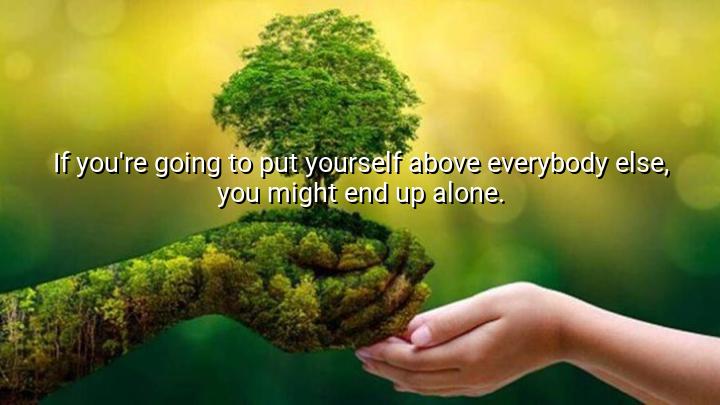




The quote "If you're going to put yourself above everybody else, you might end up alone" by Joseph Gordon-Levitt serves as a caution against arrogance, self-centeredness, and ego-driven behavior. Gordon-Levitt suggests that when someone consistently prioritizes their own needs, opinions, or importance over others, they risk damaging relationships and alienating the people around them. The message is simple but powerful: placing yourself above others may come at the cost of companionship and connection.
Joseph Gordon-Levitt, an accomplished actor, filmmaker, and entrepreneur, has often spoken about the importance of collaboration and humility in both life and the creative process. This quote reflects his belief in the value of empathy and mutual respect. In both personal and professional environments, those who act with entitlement or superiority often find themselves isolated, not because they lack talent, but because they lack relational balance.
The quote highlights a core truth about human relationships: they require equality, vulnerability, and give-and-take. When someone always seeks to be on top or to dominate, they may push others away—creating emotional or even physical distance. Over time, this behavior leads to loneliness, not because others have failed them, but because they failed to connect on a genuine level.
Ultimately, Gordon-Levitt’s quote is a reminder to stay grounded and humble. True connection comes not from placing oneself above others, but from meeting people eye-to-eye—with respect, care, and shared humanity. In choosing equality over ego, we create space for lasting and meaningful relationships.

Mmamura
This quote makes me think about leadership and friendship. A true leader or friend doesn’t need to be ‘above’ to be valued. But when someone constantly asserts superiority, it sends the message that others are lesser or disposable. I wonder how much of this stems from insecurity masked as confidence. Do people who elevate themselves above others actually feel alone to begin with—and does that create a self-fulfilling prophecy?
UGUser Google
Reading this, I’m struck by how subtle this trap can be. You might not even realize you’re putting yourself above others—maybe it’s in the tone you use, or how often you interrupt. Over time, those small behaviors can erode trust and closeness. I wonder how often people end up alone not because they wanted to be, but because they didn’t realize how they were treating the people around them.
TEDakota Phenix Tran Eubanks
There’s a warning in this quote that feels both timeless and very modern. Social media culture almost encourages us to perform a better version of ourselves all the time. But does that constant one-upmanship come at the cost of authentic connection? I’ve noticed that people who always have to win or be admired tend to push others away. It’s like vulnerability and humility are the real glue in relationships.
MQnguyen minh quan
This quote hits home in today’s hyper-competitive culture. We’re often taught to stand out, be exceptional, and ‘rise above.’ But at what cost? It makes me ask: do we unintentionally sabotage relationships by always needing to be right, or the best? Is the price of admiration loneliness? I think this quote reminds us that being part of a community sometimes means choosing connection over being superior.
VBVan binh
I think this quote carries a quiet truth that’s often overlooked. Relationships require humility, and when someone consistently places themselves above others, it creates emotional distance. But what if someone puts themselves above others not out of arrogance, but from fear or insecurity? I wonder if the root of this behavior is always pride, or sometimes just a lack of emotional safety. Either way, the isolation that follows can be heartbreaking.