

If words are not things, or maps are not the actual territory, then, obviously, the only possible link between the objective world and the linguistic world is found in structure, and structure alone.
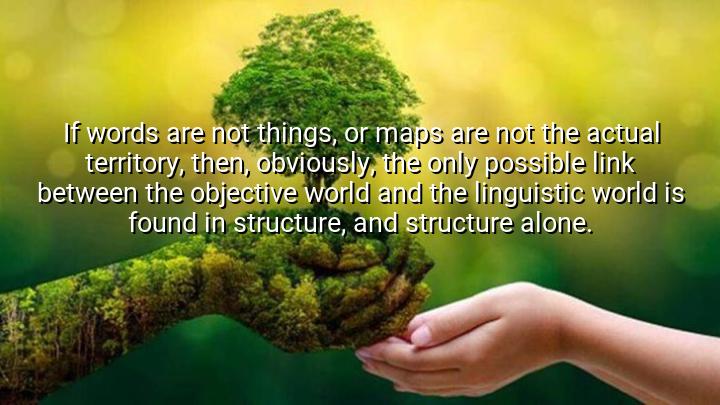




The quote "If words are not things, or maps are not the actual territory, then, obviously, the only possible link between the objective world and the linguistic world is found in structure, and structure alone" is from Alfred Korzybski, a Polish-American philosopher and scientist, known for developing the theory of general semantics. In this statement, Korzybski emphasizes that words and maps are symbolic representations, not actual things or territories. This distinction underscores his belief that human language and symbols cannot fully capture the complexity of the objective world—they are merely abstractions.
Korzybski's assertion that "structure" is the only link between the objective world (the world as it truly exists) and the linguistic world (the world of language and meaning) suggests that language functions through specific patterns or structures that attempt to reflect reality. However, the structure of language is an imperfect and simplified representation of the complexity of the real world. This idea is central to his theory of general semantics, which holds that meaning is created through the relationship between words, symbols, and the experiences they represent.
By stating "structure alone", Korzybski points out that while words and maps are useful for communication and understanding, they must be understood as part of a system of relationships rather than as exact replicas of the world. The structure of language allows us to interpret and make sense of the world, but it does so in a way that is always indirect and subject to interpretation. He suggests that the structure of language shapes how we perceive and interact with the world, but it remains a separate, abstract layer from the actual reality.
In essence, Korzybski’s quote stresses the limitations of language and symbols in representing the true nature of the world. It highlights that while words and maps are important tools for understanding, they are fundamentally different from the things they represent, and only through the structure of language can we bridge the gap between our subjective experiences and the objective world around us. This concept calls for a more mindful approach to language and communication, recognizing its limitations and the role of structure in shaping our understanding.

Nnhan
This quote makes me think about science and how it uses models to represent reality. Just like maps aren't the terrain, equations and theories aren’t the phenomena—they’re structured ways to understand it. But does focusing only on structure risk stripping away the nuance and ambiguity that reality often includes? Is there room in this structural view for intuition, experience, or subjectivity? It feels like a very sharp but narrow lens.
TTHong Nguyen Tran Tu
What I find powerful here is the emphasis on structure as the only reliable connector between words and reality. But then, isn’t structure itself a human construct too? If structure is our only bridge, does that mean reality is forever filtered through a lens we created? That’s both unsettling and fascinating. It makes me wonder whether any language—natural or mathematical—can ever claim to be ‘objective.’
KTLe Ngoc Khanh Tang
This quote is dense but fascinating. It reminds me of how misunderstandings happen not because of the content itself, but because people interpret structure differently. Is that why debates often go nowhere—because we’re not aligned in how we structure meaning, even if we use the same words? It makes me wonder if effective communication is more about aligning structures than clarifying definitions.
CDNguyen Cong Dat
Korzybski’s insight makes me think about how much we take language for granted. We act like words represent reality, but they’re just tools—abstractions. If structure is the only bridge between language and reality, then how do metaphor and poetry fit into this? Are they just distorted maps, or can they actually hint at deeper truths that rigid structural logic might miss? I’d love to explore that paradox further.
GDGold D.dragon
This quote really challenges how I think about language. If words aren’t the things themselves, then all we ever do is describe structure, not substance. But that raises a question for me—how reliable is our communication if we're only mapping structural relationships and never truly capturing the reality itself? Does that mean every interpretation is just an approximation, and perfect understanding is always just out of reach?