

I was feeling kind of lonely and started singing All alone at the end of the evening, and the bright lights have faded to blue.' And it went from there.
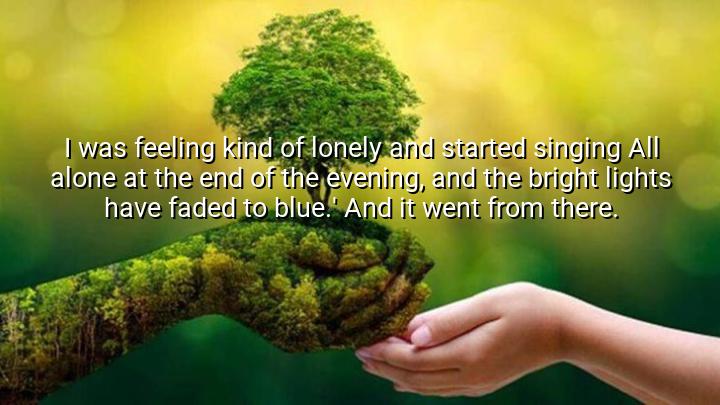




In this quote, Randy Meisner, an American musician best known for his work with Eagles, reflects on the inspiration behind a song he created while feeling lonely. The lyrics, "All alone at the end of the evening, and the bright lights have faded to blue," came to him in a moment of emotional vulnerability. He shares how this feeling of isolation led him to begin singing, and from that moment, the song began to take shape. This suggests that loneliness can often be a catalyst for creativity and expression.
Meisner's experience highlights how personal emotion—such as loneliness—can translate into meaningful artistic output. The specific imagery of bright lights fading to blue evokes a sense of the end of a night or a sense of emptiness that follows after moments of social activity or public life. This visual element enhances the feeling of isolation and mirrors the emotional state Meisner was experiencing. It shows how emotions, when channeled properly, can lead to the creation of art that resonates with others.
The origin of this quote likely stems from Meisner’s time in the music industry, particularly during his time with Eagles and his later solo career. As a member of a successful band, he would have experienced moments of loneliness and disconnect, despite being surrounded by the busy life of touring and performing. His ability to use those feelings of isolation to create a song that many could relate to speaks to his artistic talent and his connection to human emotion.
In essence, Meisner’s quote shows the therapeutic and creative power of music. It illustrates how personal feelings, like loneliness, can inspire an artist to create something meaningful. By expressing his own vulnerability, Meisner not only found a way to cope with his emotions but also created a piece of music that would resonate with others who might share similar feelings.

NMthang nguyen minh
This quote almost feels like the start of a story or a song that invites the listener into a private moment. What do you think Randy meant by ‘and it went from there’? Is he referring to a creative spark, a change in his emotional state, or something else entirely? It prompts me to think about how small moments can trigger significant shifts in our lives, especially when tied to music or memory.
NQNguyen Thi Nhu Quynh
I find it fascinating how Randy Meisner’s brief description evokes a vivid scene without much detail. It makes me wonder: what was going on in his mind at that moment? Was he seeking comfort, or was he surrendering to the loneliness? How might this experience resonate with listeners who have felt isolated? Could it be that the simplicity of his words adds to the emotional weight, making it more impactful?
PPphuong pham
Reading this makes me reflect on how loneliness can sometimes inspire creativity or self-expression. Do you think Randy was aware that this moment of singing would evolve into something bigger? It raises questions about how artists transform personal feelings into something relatable and enduring. Also, does this suggest that moments of isolation might be necessary for artistic breakthroughs, or could they be purely coincidental?
TThanh
There’s something haunting yet beautiful about that image of fading lights and solitude. I wonder if Randy Meisner intended this as a literal memory or if it’s a metaphor for the end of something important in his life. What do you think the significance of 'All alone at the end of the evening' is in the larger context of his emotional journey? Could this be a universal expression of feeling disconnected in a world that keeps moving?
VCPham Van chinh
This quote really captures a moment of vulnerability and loneliness that many people can relate to. I'm curious, do you think the act of singing during such moments helps Randy Meisner process his feelings, or is it more of a spontaneous reaction? Also, how do the ‘bright lights fading to blue’ metaphorically represent the emotional shift he’s experiencing? It makes me wonder how often music serves as a companion in times of solitude for different individuals.