

I was born by myself but carry the spirit and blood of my father, mother and my ancestors. So I am really never alone. My identity is through that line.
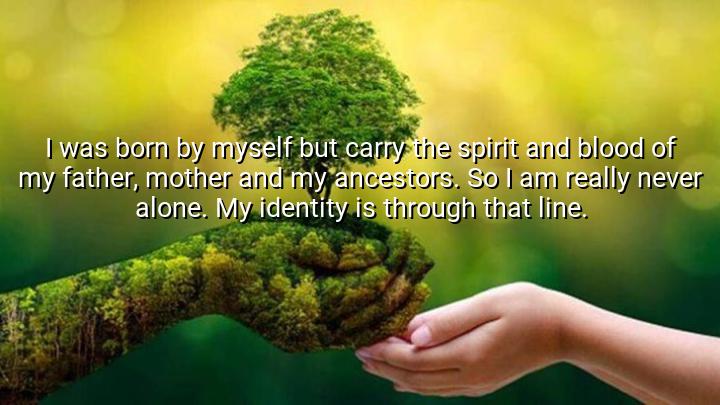




The quote "I was born by myself but carry the spirit and blood of my father, mother and my ancestors. So I am really never alone. My identity is through that line" by Ziggy Marley reflects on the deep connection between individuality and ancestral heritage. Marley suggests that while we are physically born as individuals, we are never truly alone because we carry the legacy of our parents, ancestors, and the cultural or spiritual heritage that shapes our identity. This highlights the idea that our sense of self is deeply intertwined with the generational connections that precede us.
Ziggy Marley, a Jamaican musician and the son of the legendary Bob Marley, has always emphasized themes of family, roots, and legacy in his music and public life. In this quote, he speaks to the importance of understanding one’s heritage and the powerful influence that the spirit of past generations has on shaping personal identity. Marley’s connection to his family and ancestry is a source of strength, helping him feel rooted and supported, even in moments of solitude.
The phrase "I am really never alone" underscores the idea that solitude does not mean emotional isolation. Instead, it is a recognition that we are always connected to something greater than ourselves—whether it’s through the memories, values, or bloodlines of our forebears. Marley's sense of identity is strengthened by this lineage, giving him a deep sense of belonging and continuity in the world.
Ultimately, Marley’s quote emphasizes that our individual existence is enriched by the presence of our ancestors and the legacy they leave behind. It suggests that identity is not only defined by personal experiences but also by the connections to the past, forming a spiritual lineage that provides a sense of belonging and guidance. Through this lens, solitude becomes not a state of isolation, but a reminder of the unbroken thread that links us to those who came before.

DWDuong Wibu
Ziggy’s words carry a sense of pride and rootedness that’s really admirable. But what about people who were adopted or don’t know their biological lineage? Can they find the same kind of identity through chosen family or cultural connection? This quote makes me reflect on how identity is not just inherited but also built, and how both can coexist in shaping who we are.
THNguyen Thi Thu Hien
This quote feels spiritual to me, like there’s a sense of invisible community always with you. It’s beautiful, but I’m left wondering—how do we tap into that ancestral connection in our daily lives? Is it through tradition, storytelling, or something more intuitive? And what about those of us living far from our roots—can we still feel that presence, or does distance dilute the connection over time?
UGUser Google
I love the sense of continuity in this quote. It feels like Ziggy Marley is reminding us that we’re not isolated beings—we’re part of a longer story. But I wonder how this perspective influences the choices we make. Does thinking about our ancestors make us more accountable for our actions? Or could it sometimes feel like pressure to live up to something that’s not entirely our own?
NLngo ly
There’s something deeply grounding about this idea—that identity isn’t just personal, it’s historical. But I’m curious: does placing so much importance on lineage limit our sense of self, or does it empower it? What happens when someone wants to break from their family’s legacy, especially if it’s painful or toxic? Can we both honor where we come from and still forge a completely independent identity?
GGGiang Giang
This quote really speaks to the power of ancestral connection. It makes me think: how much of who we are is shaped by bloodline versus personal experience? Ziggy Marley seems to find comfort and strength in his lineage, but I wonder if everyone feels that way. What about people who are estranged from their families or disconnected from their heritage? Can identity still be rooted in ancestry if that connection is complicated or unknown?