

I want to be alone.
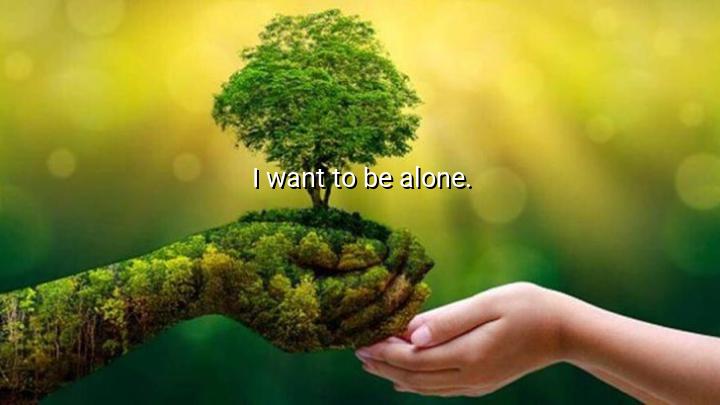




The quote "I want to be alone" by Greta Garbo is a famous expression of solitude and independence. Garbo, a legendary Swedish-American actress known for her work in silent and early talkie films, was often perceived as a mysterious and private figure. This quote, which she said in the 1932 film Grand Hotel, became iconic as it reflects her desire to escape the pressures of fame and public attention. It symbolizes her need for personal space and peace, away from the overwhelming demands of her celebrity life.
Greta Garbo was celebrated for her complex and emotionally nuanced performances, but her real-life persona was marked by a deep need for privacy. She famously withdrew from acting in her early forties, choosing to live a reclusive life away from the public eye. This quote captures Garbo’s personal struggles with the intrusion of fame and her desire to reclaim control over her own life, free from constant scrutiny.
The simplicity of "I want to be alone" reflects Garbo's assertiveness in expressing her personal boundary. In a world that often celebrates social interaction, companionship, and extroversion, her statement is a bold declaration of the value of solitude. It suggests that sometimes, being alone is not about loneliness, but about finding comfort and clarity in one's own company.
Ultimately, Garbo’s quote remains a timeless reminder of the importance of self-reflection and the need for personal space. It emphasizes that, while social engagement can be fulfilling, there is also great value in choosing solitude when it is necessary for emotional well-being and mental peace. Her words continue to resonate with anyone who has ever sought quiet time to reconnect with themselves.

TTThanh Trieu
I wonder how different this quote would sound if it came from a man instead of a woman. Greta Garbo’s words have always been interpreted with a kind of tragic mystique, but if a man said the same thing, would it be seen as strength or stoicism? There’s definitely a gendered lens through which we view solitude. Maybe her quote endures because it quietly resists those expectations.
TTNguyen Thu Trang
There's something timeless about this quote. It’s amazing how four words can say so much. Do you think the desire to be alone is misunderstood in society? Often, people equate it with sadness or dysfunction, but maybe it's just a way of returning to oneself. I’d love to know if Garbo ever explained what she meant in detail—or if the mystery of it was part of its magic.
LNQuoc Loc Nguyen
This quote feels like it could either be a declaration of empowerment or a quiet admission of loneliness. That ambiguity fascinates me. Is the desire to be alone rooted in peace or pain? I’ve had moments where being alone felt like liberation, and others where it felt like resignation. It would be interesting to explore what emotional state makes someone utter these words with either relief or sadness.
NBNguyen Trong Nam Binh
I find this quote haunting and powerful. It makes me ask: in a world that constantly demands our attention and performance, what does it really mean to claim solitude? Is wanting to be alone an act of rebellion, or a form of self-preservation? I think more people feel this way than they admit, especially those who are highly sensitive or frequently in the spotlight, like Garbo was.
GDGold D.dragon
This quote is so simple yet so loaded with emotion. When someone says they want to be alone, is it always a cry for space—or could it sometimes be a quiet way of expressing emotional overwhelm? I wonder what kind of solitude Garbo meant: peaceful withdrawal, or protective isolation? It’s interesting how this line became so iconic, and maybe that says something about how deeply people relate to it.