

I used to wonder if it was God's plan that I should be alone for so much of my life. But I found peace. I found happiness within people and the world.
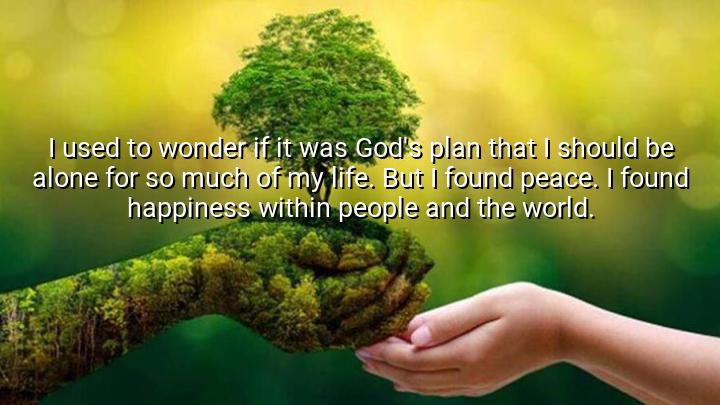




In this quote, Lana Del Rey reflects on her initial feelings of loneliness and her contemplation of whether it was part of God's plan for her to spend so much of her life alone. She expresses a sense of uncertainty about her solitude and seeks meaning in it, questioning if it was a divine or fated part of her journey. This highlights the introspective nature of the artist, exploring her emotional experiences and the search for purpose in moments of isolation.
However, Del Rey ultimately finds peace and happiness not in solitude but in connecting with people and engaging with the world around her. This transformation reveals a shift in her perspective: while she initially struggled with being alone, she discovers fulfillment and joy through her relationships with others and her interactions with the broader world. The quote suggests that even in moments of isolation, there is potential for personal growth and connection that can bring profound contentment.
The message of the quote is one of self-discovery and acceptance. Del Rey moves from questioning her fate and experiencing loneliness to embracing the love and joy that can be found through human connection. She reflects on the importance of community and finding solace not only in oneself but in the people who surround us.
Ultimately, Del Rey’s quote speaks to the idea that happiness is not solely dependent on external circumstances like being with others, but on how we engage with the world around us. It encourages embracing both solitude and connection, suggesting that finding peace within oneself and with others is key to a fulfilling life.

NVChung Nguyen van
This quote reminds me that personal peace often comes from a shift in perspective. Lana moves from questioning fate to embracing presence, which I find inspiring. But I’m also wondering—does this kind of peace require forgiveness? Of oneself, of others, or even of life’s circumstances? Maybe happiness doesn’t erase the loneliness we’ve experienced but helps us understand it differently. That’s a kind of healing I want to believe is possible.
TTam
There’s such a quiet strength in this quote. I admire how it acknowledges suffering without turning bitter. But I also wonder—how do we reconcile spiritual uncertainty with emotional healing? If someone feels like life has left them alone, how do they rebuild trust in others and the world? I’d love to explore how belief systems, whether religious or not, impact the way we process solitude and healing.
QCDu Quoc Chinh
This quote really resonates with anyone who’s gone through emotional or existential loneliness. What strikes me is the transformation—it’s not about erasing solitude, but discovering something beautiful beyond it. I’m curious how she defines 'happiness within people.' Is it about community, friendship, love? And how do we find that kind of connection without losing the self we’ve built through solitude? There’s something profound in that evolution.
MLMuoi Le
I feel deeply seen by this quote. It captures how isolation can feel divinely orchestrated at times, like there’s some greater lesson behind it. But I also wonder—how do you know when you’ve moved from solitude to true connection? Lana says she found happiness in people and the world, but did she have to change, or did her surroundings change? That transition fascinates me, especially for anyone going through something similar.
APDuy Anh Pham
Lana’s reflection speaks to the tension between spiritual questions and personal growth. I love how she reframes loneliness as a journey toward inner happiness and connection with the world. But it makes me wonder—does peace only come after acceptance, or can it coexist with longing? For those still in the midst of solitude, is it enough to believe peace will eventually arrive, or does that depend on action and mindset?