

I think the greatest amount of pressure is the pressure I place on myself. So in a way I chose to be alone.
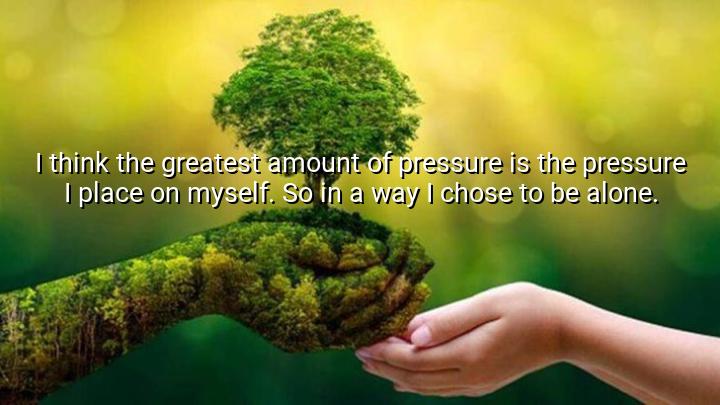




The quote "I think the greatest amount of pressure is the pressure I place on myself. So in a way I chose to be alone" by Cathy Freeman reveals the intense internal drive and self-discipline required to pursue personal excellence. Freeman acknowledges that the most significant expectations she faces are not from others, but from within. This kind of self-imposed pressure often leads individuals to seek solitude, not out of loneliness, but as a deliberate choice to stay focused and in control of their own path.
Cathy Freeman, an Australian Olympic gold medalist and track athlete, is best known for her victory in the 400 meters at the 2000 Sydney Olympics, a defining moment in Australian sports history. As an Indigenous athlete in the global spotlight, she carried not only her personal ambitions but also the hopes of a nation. In this quote, Freeman reflects on the mental and emotional weight that comes with striving to meet her own high standards.
The statement “I chose to be alone” is powerful—it reframes aloneness as a form of empowerment and intentional focus. Rather than seeing solitude as a lack of support or companionship, Freeman suggests that it’s sometimes necessary to distance oneself from distractions in order to meet one's goals. This kind of solitude becomes a space for clarity, determination, and self-mastery.
Ultimately, Freeman’s quote highlights the deeply personal nature of pressure, ambition, and solitude. It speaks to anyone who has ever pushed themselves toward a dream and discovered that, in order to succeed, they must sometimes walk the road alone. Her words remind us that solitude can be a choice, and even a strength, in the pursuit of greatness.

HLDam Hoang Linh
I admire the honesty in this quote—it’s brave to admit that sometimes solitude is a choice tied to self-expectation. But I also wonder, does being alone in those moments help you get closer to your goals, or does it simply quiet the noise long enough to breathe? There’s a subtle tension here between independence and emotional exhaustion. It raises the question: can we learn to carry our standards without carrying them alone?
NVNgoc Vu
This really made me reflect on how pressure and isolation are sometimes two sides of the same coin. I’ve definitely stepped away from people when I felt overwhelmed—not because they were the cause, but because I didn’t want to show how much I was struggling. I’m curious: does solitude in this context offer healing, or does it just prolong the pressure cycle by removing accountability or perspective?
TNPham Ta Thanh Nga
There’s a quiet intensity to this quote. It makes me question—why do so many of us place the highest expectations on ourselves, even more than others do? And when we do, do we isolate because we need quiet, or because we’re afraid others won’t understand the weight we carry? This makes me think about the connection between ambition, emotional resilience, and the need for solitude as protection.
Kkieutrinh9798
I find this quote deeply honest. It highlights how being driven can also lead to isolation, even if it’s voluntary. But is that solitude empowering or self-punishing? When does time alone serve as a tool for focus, and when does it become a shield from vulnerability? I’d love to know whether Cathy Freeman found peace in her solitude or if it was more of a sacrifice to meet her own standards.
TT7A5 Nguyen Thi Thuy Trang
This quote feels incredibly personal and relatable. It makes me think about how much of our stress really is self-imposed. But I also wonder—does choosing to be alone help manage that pressure, or does it amplify it by removing the emotional support we might need? I admire the self-awareness here, but is solitude always the healthiest coping strategy when dealing with perfectionism or internal expectations?