

I think it's just being good every single day and being there for my teammates. I know that I can't do it alone, and they can't do it alone, and we've got to lean on each other.
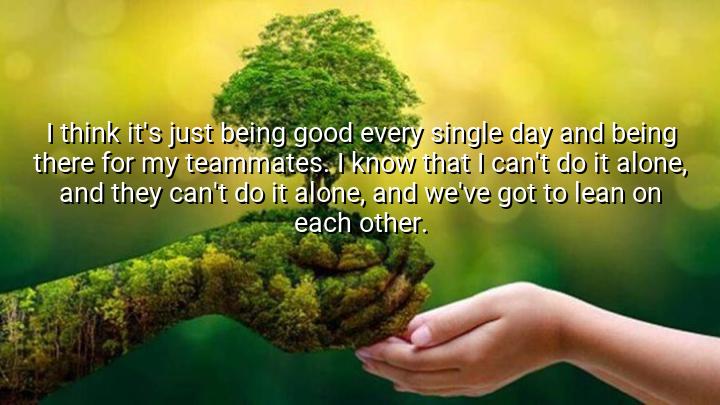




In this quote, Jordan Larson, an American professional volleyball player, speaks about the importance of consistent effort, teamwork, and mutual support in achieving success. She emphasizes the value of being good every single day, suggesting that maintaining a high level of performance and commitment is crucial in both individual and team sports. Larson acknowledges that achieving success is not solely dependent on her own abilities but on the collective effort of the entire team.
Larson’s statement highlights the interdependence among teammates in sports. She recognizes that while each player brings unique skills and strengths, no one can succeed alone. The idea of leaning on each other emphasizes the importance of collaboration, trust, and shared responsibility. By acknowledging that both she and her teammates need to rely on one another, Larson stresses that teamwork is a fundamental component of success in volleyball and other team sports.
The origin of this quote likely comes from Larson's extensive career in volleyball, where she has played at the highest levels, including the Olympics and professional leagues. As a key player for the U.S. women's national volleyball team, she has experienced firsthand how teamwork and support are critical to achieving victory. Her statement reflects the values she holds as an athlete and leader, emphasizing the importance of collective effort over individual glory.
In essence, Larson’s quote underscores that success in sports, and life in general, is rarely achieved in isolation. It speaks to the power of teamwork, where individuals come together to contribute their unique strengths and support one another through challenges. By acknowledging that no one can do it alone, Larson highlights the importance of collaboration, mutual trust, and collective effort in reaching common goals.

KTkieens tri
It’s inspiring how this perspective values daily effort and emotional support equally. But I’m interested in the challenges behind this ideal. How do they maintain motivation and accountability when progress isn’t visible? Also, are there moments when leaning on teammates isn’t enough—how do they cope then? Exploring these nuances could give deeper insight into the resilience and mental health strategies behind successful teams.
YTYen Thanh
The quote resonates as a reminder that no one excels in isolation. I’m curious how this mindset shapes leadership within the team. Does Jordan take on a mentorship role, or is it more about shared responsibility? How do they celebrate collective victories and manage individual frustrations? This philosophy could have broader implications about how society views collaboration—could embracing interdependence help combat toxic individualism?
MTTue Man Tran
This makes me think about how consistent dedication and teamwork contribute to success beyond talent alone. Is ‘being good every single day’ more about physical preparation, mental toughness, or both? Also, how does leaning on each other avoid becoming a crutch? Finding the right balance between independence and interdependence seems crucial. I wonder how Jordan navigates this balance during competitions and training, especially in high-stakes moments.
NVNGUYEN THI NGOC VAN
I love the emphasis on mutual reliance in this statement. It suggests a healthy, supportive team culture rather than a focus on individual stars. But does this mean that vulnerability is encouraged, allowing teammates to admit weaknesses and ask for help? How might this approach impact team performance under pressure? It would be interesting to explore whether this philosophy applies only in sports or if it can be effectively translated into other collaborative environments like workplaces or communities.
DQhoang duc quan
This quote highlights the importance of teamwork and consistent effort. I wonder how Jordan Larson balances individual responsibility with collective success. Is there a particular daily routine or mindset that helps maintain this ‘being good every single day’? It also raises questions about the dynamics within the team — how do they handle moments when someone struggles? I’d be curious to know how this philosophy has evolved through her career and what advice she’d give to teams facing challenges.