

I paint self-portraits because I am so often alone, because I am the person I know best.
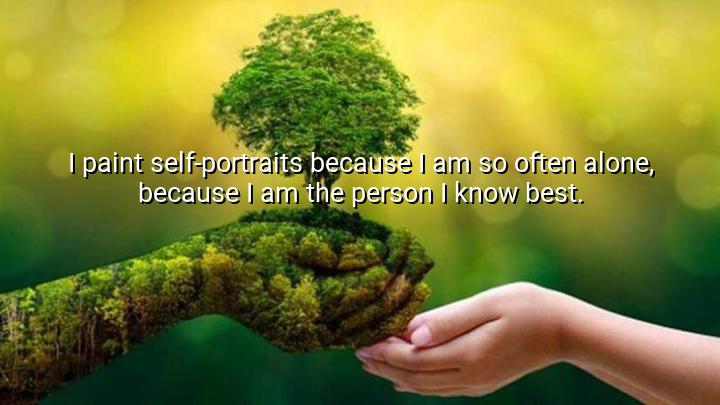




The quote "I paint self-portraits because I am so often alone, because I am the person I know best" by Frida Kahlo speaks to her deeply personal relationship with solitude and self-expression. Kahlo suggests that her frequent loneliness and the fact that she understands herself better than anyone else make her the most natural subject for her art. The self-portrait becomes a way for her to explore and communicate her inner world, both as a means of self-reflection and a way to make sense of her own emotions and experiences.
Frida Kahlo, a Mexican painter known for her striking and often surreal self-portraits, used her art to confront themes of pain, identity, and personal struggle. Her life was marked by significant physical and emotional hardships, including a severe injury and tumultuous relationships. The act of painting herself became a therapeutic tool, allowing her to process her suffering and isolation, as well as assert her identity in a world where she often felt misunderstood or marginalized.
The phrase "I am the person I know best" underscores Kahlo’s deep introspection. It reflects the notion that solitude gives her the opportunity to connect with herself in a way that she might not be able to do with others. Through her self-portraits, Kahlo not only expresses her emotional and physical pain, but also asserts her authenticity and individuality. Her work was a powerful statement about the importance of knowing and understanding oneself, particularly in the face of external challenges.
Ultimately, this quote highlights how art—particularly self-portraiture—can be a profound method of self-exploration and healing. Kahlo’s self-portraits became a medium through which she could represent the complexity of her identity and the struggles she faced in her life. Her words remind us that sometimes, in moments of loneliness or isolation, we may turn inward and discover deeper connections with ourselves through creative expression.

HLTruong Thi Hong Linh
Frida’s quote makes me think about how much of ourselves we actually hide in daily life. Maybe self-portraiture is a way to reveal what we don’t show others. But is it always truthful, or still a kind of performance? Do we project the version of ourselves we want to believe in, even in solitude? That tension between honesty and self-construction feels very human and very compelling.
THVi Thi Hue
What strikes me is Frida’s honesty. She doesn’t paint herself out of vanity, but out of familiarity and presence. It makes me ask: how many of us could say we truly know ourselves enough to depict that knowledge in art—or even in words? Her quote challenges me to consider how solitude, rather than loneliness, can become a place of empowerment and insight.
ATAnh Tu
This line resonates with me deeply. There’s something powerful about turning to yourself when others aren’t there. But it also makes me question—can focusing so heavily on oneself become isolating in itself? Is there a risk in creating a feedback loop of self-reflection that cuts off connection with others? I’d love to hear how people balance introspection with meaningful external relationships.
DHDiep Huynh
There’s a quiet sadness in this quote, but also so much strength. It makes me wonder: does being alone enhance creativity, or is it simply a condition that many artists adapt to out of necessity? Frida seems to accept solitude, maybe even find empowerment in it. Could this be why her work feels so intimate and raw—because it’s rooted in unfiltered self-examination?
THVu Thu Hien
This quote really makes me think about the relationship between solitude and self-awareness. Is it only through being alone that we come to truly know ourselves? I wonder if Frida’s self-portraits were more about exploration than expression—like mapping her inner landscape. Can art be a kind of mirror that not only reflects but deepens self-understanding? How might this apply to people who don’t identify as artists but still seek identity clarity?