

I only go out to get me a fresh appetite for being alone.
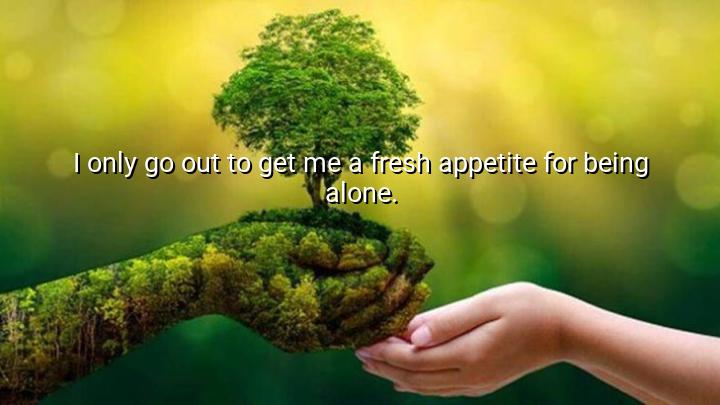




The quote "I only go out to get me a fresh appetite for being alone" by Lord Byron humorously captures a deep appreciation for solitude. Rather than seeking social interaction for its own sake, Byron implies that his time spent with others serves primarily to reinvigorate his desire for being alone. It reflects a personality that finds true comfort, clarity, or even pleasure in solitude, using social moments as a contrast to heighten the joy of returning inward.
Lord Byron, a leading figure of the Romantic movement in 19th-century English literature, was known for his flamboyant lifestyle, emotional depth, and frequent introspection. Though he was often surrounded by admirers and controversy, Byron also wrote extensively about loneliness, melancholy, and the inner life of the artist. This quote, in particular, expresses a Romantic ideal—valuing solitude as a space for self-discovery, inspiration, or peace.
The phrase "fresh appetite for being alone" is striking. It treats solitude not as something to be avoided, but as something to be savored—like a nourishing meal one eagerly returns to after a taste of something else. Byron turns the common idea of socializing on its head; instead of escaping loneliness by going out, he finds solitude to be the main course, and society just the appetizer.
Ultimately, Byron’s words celebrate the richness of inner life and the value of being comfortable with oneself. In an era—and a world—where social activity is often glorified, this quote reminds us that choosing to be alone isn’t necessarily sad or antisocial. For some, like Byron, it’s a deeply fulfilling and even joyful state of being.

QVQuynh Vu
It’s funny how this quote flips the script. Instead of solitude being a break from people, people become the break from solitude. That really challenges how we define balance. Can solitude be someone’s default state of happiness, while connection is just a brief intermission? I’d love to explore whether this preference reflects a personality trait or a coping strategy in an overstimulating world.
LHTuyet Luc Hy
This is such a poetic expression of a modern-day feeling. It makes me wonder: do we sometimes socialize out of obligation or routine, rather than genuine connection? I love the idea that solitude can be something to savor — not something to be fixed. Do you think more people would enjoy being alone if it weren’t so stigmatized as ‘anti-social’ or sad?
HHAU
This quote really resonates with me as someone who needs alone time to recharge. It’s interesting how being around others can actually enhance your appreciation for solitude. But I’m curious — is this mindset healthy, or could it slip into avoidance? How do you know when solitude is serving you, versus when it’s becoming a form of emotional withdrawal or isolation?
TNTrinh Thao Ngan
I find this quote fascinating and a bit cheeky. It seems to express a deep love for solitude, almost like it’s the main course and socializing is just the appetizer. But is that a sign of introversion or maybe even social fatigue? I wonder how many people feel this way but don’t admit it because we live in a culture that often glorifies constant interaction and extroversion.
NHNam Nguyen Hai
This quote makes me smile — it’s such a witty and unexpected reversal of how we usually think about socializing. I wonder, is this a clever way to reframe solitude as a reward rather than a fallback? Could some people actually find more comfort in solitude not because they dislike others, but because being alone allows them to reconnect with themselves more authentically? It makes me think differently about social energy.