

I live alone, with cats, books, pictures, fresh vegetables to cook, the garden, the hens to feed.
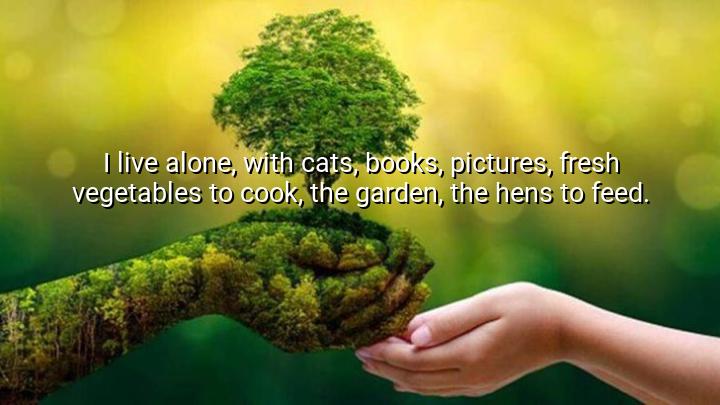




In this quote, Jeanette Winterson, a British author known for her work exploring themes of identity and love, describes her solitary life filled with the simple pleasures of independence and nature. She emphasizes the elements that bring her contentment: cats, books, pictures, and fresh vegetables to cook. These items represent the nurturing and grounding aspects of her life, suggesting that she finds joy and fulfillment in quiet, personal moments rather than in socializing or seeking external validation.
Winterson’s mention of the garden and the hens she feeds further underscores her connection to the natural world. These references evoke images of self-sufficiency and the peaceful rhythms of life that come from tending to the earth and animals. Her lifestyle appears to be a balance of solitude and purposeful activity, where she engages with the world around her in a nurturing and mindful way, finding satisfaction in the simplicity of daily tasks.
The quote also reflects Winterson’s embrace of solitude as a choice, suggesting that she is content with her own company and finds meaning in her daily routines. The presence of books and pictures suggests that she values intellectual and emotional nourishment, using them as tools for reflection and expression. Her life, though solitary, is rich in creativity, sustenance, and connection to nature, indicating that she finds depth in a life that might seem minimal or quiet to others.
Ultimately, Winterson’s words highlight her preference for a simple, self-sufficient existence, where solitude is not seen as lonely, but rather as an opportunity for self-care, reflection, and engagement with the natural world. The combination of intellectual, emotional, and physical elements she surrounds herself with paints a picture of someone who cherishes independence and finds deep satisfaction in the small joys of life.

N7Xuan Phat Nguyen 7C
There’s something profoundly intentional about this way of living—surrounded by beauty, books, and life’s basic essentials. It feels almost like a rejection of modern chaos. But I’m curious: does this lifestyle come after experiencing the hectic world, or does it appeal mostly to those who have always been more introspective? Is this retreat or arrival? I'd love to hear how others interpret it emotionally and philosophically.
HLTran Hoang Lan
This quote makes me think deeply about the role of companionship—both human and non-human—in our lives. Could living with animals and tending to a garden fulfill emotional needs in the same way that close human relationships do? Or is this a different kind of emotional nourishment altogether? It really challenges my assumptions about what makes a life full and satisfying.
MLMinh Le
Is this kind of lifestyle accessible to most people? I mean, with today's fast-paced work demands, urban housing, and economic pressures, is it really feasible to live with this level of calm and self-containment? Or is this more of an idealized escape than a practical reality for the majority of us? I’d love to discuss whether this represents freedom or privilege—or maybe a bit of both.
TLThao Ly
Honestly, this sounds like my dream life. Quiet, animals, books, and a connection to nature. But I also wonder—can such a life become isolating over time, or does the daily rhythm of tending to simple things keep loneliness at bay? I'm fascinated by the idea of finding joy in routine. Does anyone else feel that there's a kind of freedom in this simplicity?
GDGold D.dragon
There's a certain charm and self-sufficiency in this quote that I find incredibly admirable. But it raises a question—how does one strike a balance between solitude and social connection? Is this kind of life sustainable long-term, especially in moments of crisis or emotional vulnerability? I'd love to hear from people who've chosen a similar lifestyle: do you ever crave more interaction, or is the quiet enough?