

I have to stay alone in order to fully contemplate and feel nature.
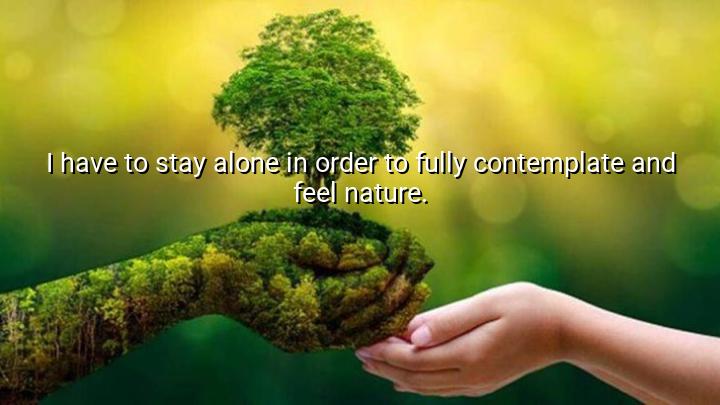




In this quote, Caspar David Friedrich, a German Romantic painter, expresses the need for solitude in order to deeply connect with and contemplate the natural world. He believes that to truly experience the essence of nature, one must be removed from the distractions and influences of society. Friedrich’s emphasis on being alone reflects a central tenet of Romanticism, where personal, emotional experiences of nature were considered essential for artistic and spiritual fulfillment.
Friedrich's statement highlights the idea that solitude provides the space for a more profound, unfiltered connection with the natural world. In his view, nature’s beauty and awe-inspiring qualities are best appreciated when a person is free from the noise and chaos of daily life, allowing for introspection and a deeper emotional response. This solitude is not just physical but also mental, as it enables one to fully absorb the sensory and spiritual aspects of nature.
The quote reflects Friedrich’s personal philosophy and artistic style, where he often painted vast landscapes that featured lone figures contemplating dramatic natural scenery. His works, such as Wanderer above the Sea of Fog, emphasize the emotional and spiritual connection between humans and the sublime aspects of nature. For Friedrich, the act of being alone in nature was not just about escapism, but about discovering deeper truths about the self and the world.
Ultimately, Friedrich’s quote underscores the idea that solitude can be a powerful tool for reflection and self-discovery, particularly in relation to the natural world. By removing oneself from the distractions of society, one can better attune their mind and soul to the deeper rhythms of nature, leading to a more profound experience and appreciation of the world around them.

TDNguyen Thuy Duong
What strikes me is how this quote frames solitude as a gateway, not an escape. It’s not about fleeing people, but about making space to receive something larger than ourselves. Still, I wonder—do we romanticize solitude too much? For some, being alone is painful, not peaceful. So is this a universal path to feeling nature, or does it only speak to certain kinds of sensibilities—like artists or introverts?
HTvo hong tri
There’s a romanticism in this quote that I really admire. Friedrich seems to see nature not just as scenery, but as a spiritual experience that requires solitude to fully access. It makes me ask: is solitude a kind of ritual or prerequisite for revelation in art and nature? Or is that just a personal temperament? I’d love to know whether others feel this same need to be alone to truly ‘feel’ the world.
DPDu Pham
This makes me think about how overstimulated we’ve become. Maybe Friedrich was onto something—being truly present in nature might demand that we disconnect from the noise of society and even other people. But in today’s hyper-connected world, how many of us allow that kind of solitude? Is it still possible to find those pure moments of quiet contemplation in the modern era of constant alerts and digital distraction?
MTTrang Mai Thi
I find this quote both beautiful and a little sad. It suggests that true connection with nature requires withdrawal from people. But must solitude always be the price of deep experience? Can’t companionship and nature coexist? I love the idea of reflection in solitude, but I also think some of my most profound moments in nature have come while walking quietly beside someone else. Does feeling nature mean feeling alone?
DAHOANG DIEU ANH
This quote really resonates with me. There’s something about being alone in nature that sharpens all your senses—it’s like the silence lets the landscape speak more clearly. But I wonder, does solitude actually change how we perceive beauty, or just how deeply we feel it? Is it possible to have the same contemplative experience in nature with someone else, or does shared presence inherently dilute that intimacy with the natural world?