

I hate cameras. They interfere, they're always in the way. I wish: if I could work with my eyes alone.
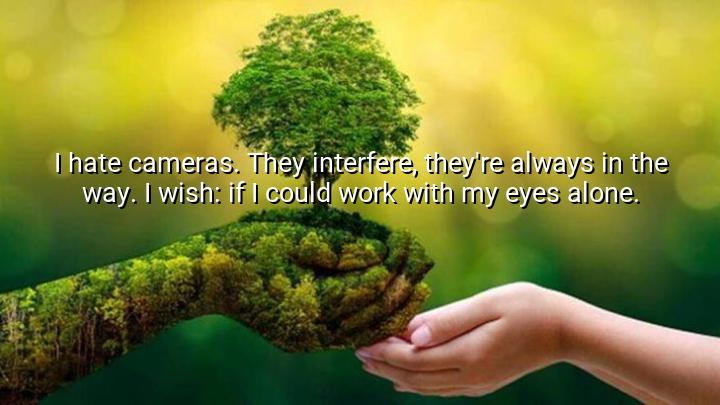




In this quote, Richard Avedon, one of the most influential fashion and portrait photographers, expresses his frustration with cameras and how they can sometimes interfere with his artistic vision. Avedon is known for his ability to capture raw, emotional moments, and in this statement, he wishes that he could create his iconic images using only his eyes, without the physical barrier of a camera. He implies that the camera itself, despite being a necessary tool, can get in the way of the intimacy and connection he seeks to achieve in his photography.
Avedon's frustration stems from the technical nature of photography, where the presence of a camera between the photographer and subject can create a sense of distance or artificiality. As a master of capturing the essence of his subjects, Avedon likely felt that the camera disrupted the natural interaction and moment he sought to immortalize. His desire to work with only his eyes suggests a longing for a more direct, unfiltered connection with the world he was trying to capture.
The origin of this quote lies in Avedon’s deep commitment to his craft and his philosophy about photography. Known for his innovative and often intimate portraits, Avedon sought to reveal the truth and vulnerability of his subjects. His frustration with the camera reveals his desire to transcend the mechanical aspect of photography and engage with his subjects in a more profound, organic way.
In essence, Avedon’s quote speaks to the tension between the technical tools of photography and the emotional, human elements that drive artistic expression. It reflects his belief that true connection and understanding could be achieved if only the camera did not stand in the way of capturing the raw essence of a person or moment.

TKTran Tran Khanh
This statement evokes a sense of frustration but also deep sensitivity to the act of seeing. Could the ‘interference’ of cameras be a metaphor for how technology mediates our experience of reality? How do you think this affects both the creator and the audience? It’s intriguing to explore how much of art’s power lies in what is left unseen or unrecorded.
TGTuong Thi Giang
Avedon’s wish to work ‘with eyes alone’ suggests a longing for purity in observation. Is this a call for more intuitive, less mediated art? How might advances in technology, like virtual reality or eye-tracking, help fulfill this vision? Or is there an inherent limitation to any tool that tries to capture human experience?
LDLe Dung
This quote makes me think about the relationship between artist and subject. If cameras are ‘always in the way,’ does that mean the act of photographing changes the subject’s behavior or the artist’s perception? How do artists balance the technical demands of their medium with the desire to capture something raw and real? It’s a compelling insight into the creative process.
Mmaimai
I’m struck by the idea that cameras can feel intrusive, almost like an obstacle to authentic creativity. Do you think this feeling is common among photographers and filmmakers? How might this impact the way art is created and experienced? It’s interesting to consider how the tools meant to preserve moments might also change the nature of those moments.
TTVu Thi Thanh Thanh
This quote reveals a fascinating tension between the artist and their tools. I wonder if Avedon’s dislike of cameras reflects a broader struggle artists face when technology feels like a barrier rather than a medium. How much does the physical presence of equipment interfere with genuine expression or connection? Could the desire to 'work with eyes alone' be about capturing a more instinctive, unfiltered perspective?