

I don't want to be alone, I want to be left alone.
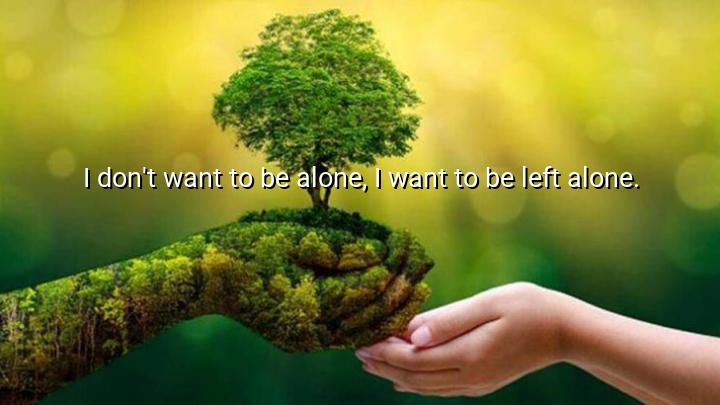




The quote "I don't want to be alone, I want to be left alone" by Audrey Hepburn expresses a subtle but important distinction between solitude and isolation. Hepburn suggests that she doesn't mind being by herself, but she desires space and peace from the demands or expectations of others. This reflects the need for personal autonomy and the freedom to exist without external interference, a desire for quiet rather than loneliness.
Audrey Hepburn, an iconic actress, humanitarian, and fashion muse, is known for her roles in classic films like Breakfast at Tiffany's and Roman Holiday. Hepburn was often seen as graceful, independent, and thoughtful both on and off the screen. This quote encapsulates her nuanced perspective on privacy and independence, revealing that her wish was not for complete isolation, but for the freedom to live life on her own terms without unwelcome external influence.
The phrase "I want to be left alone" indicates that Hepburn sought to withdraw from the pressures of fame and social expectations, finding comfort in a kind of controlled solitude where she could simply be herself. It speaks to a desire for personal space, where one can have time to think, reflect, or recharge without feeling the weight of constant interaction or societal demands.
Ultimately, this quote highlights the balance between solitude and connection. Hepburn’s words reveal a deep appreciation for peace and privacy while acknowledging that solitude, in the right context, can be deeply fulfilling. It’s a reminder that sometimes we don't crave aloneness, but rather the freedom to enjoy our own company without external distractions.

HAHai Anh
This quote resonates deeply with me. It reminds me of moments when I’m overwhelmed — not because I don’t care about people, but because I need time to recalibrate. It’s a subtle kind of exhaustion that’s hard to explain. Do you think this need to be 'left alone' is increasing with how connected we always are now? Maybe we’re more desperate for space because we’re rarely truly unplugged.
LLinh
What Hepburn says here feels like emotional nuance at its finest. It’s fascinating how much language matters — 'being alone' sounds so final and empty, but 'being left alone' carries a sense of agency and intention. I wonder if people who set this kind of boundary are seen as cold when in fact they’re just protecting their peace. How can we create more room for this kind of clarity in relationships?
AD04. Anh Duy
This quote really makes me think about introversion and how misunderstood it can be. Wanting to be left alone doesn’t mean you don’t value relationships; it might just mean you need a break from stimulation or performance. But why do people often take that personally? I wonder how we can normalize the need for solitude without assuming it’s a rejection of others.
QHTran Quang Hung-11A3
I love how this quote draws a fine but important line between loneliness and solitude. It’s not about wanting to be cut off from others — it’s about reclaiming mental or emotional space. Why is it still so difficult for people to communicate that distinction clearly? Do we live in a culture that doesn’t know how to respect boundaries unless they’re tied to dramatic separation?
DPHoang Dat Pham
This quote captures such a relatable tension — the desire for space without complete isolation. It makes me think about how we often confuse the need for solitude with a desire to disconnect from others emotionally. But clearly, they're not the same. Is it possible that many people who appear distant actually crave connection, just on their own terms? I think Hepburn nailed a feeling that's more common than we admit.