

I do not believe that sheer suffering teaches. If suffering alone taught, all the world would be wise, since everyone suffers. To suffering must be added mourning, understanding, patience, love, openness and the willingness to remain vulnerable.
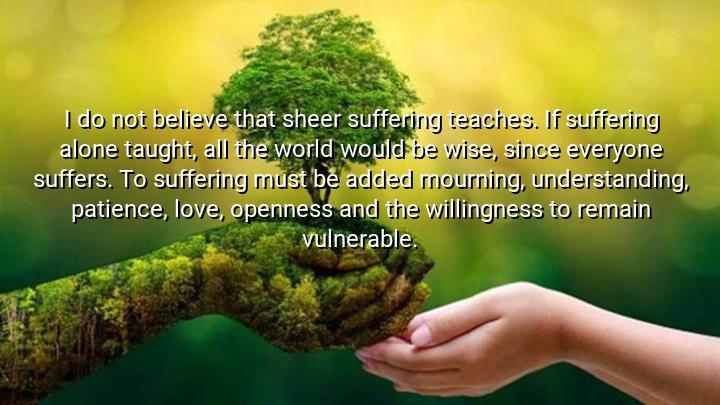




The quote "I do not believe that sheer suffering teaches. If suffering alone taught, all the world would be wise, since everyone suffers. To suffering must be added mourning, understanding, patience, love, openness and the willingness to remain vulnerable." by Anne Morrow Lindbergh highlights the idea that suffering alone does not lead to growth or wisdom. Lindbergh, an American author and aviator, acknowledges that suffering is a universal experience, but she argues that it is not enough on its own to bring about meaningful change or learning. In her view, suffering must be accompanied by other qualities such as mourning, understanding, and patience to foster true healing and personal development.
Lindbergh's statement challenges the common assumption that enduring hardship automatically leads to wisdom or personal transformation. While suffering is an inevitable part of life, it is not the experience of pain that teaches us, but how we choose to respond to it. For growth to occur, we must also bring empathy, love, and an open heart to our experiences, allowing us to process the suffering in a way that makes us more compassionate and resilient.
The emphasis on vulnerability is also crucial to Lindbergh’s perspective. She suggests that, in order to truly learn from suffering, we must remain open to our emotions and willing to face our pain without closing off or becoming emotionally numb. Vulnerability allows for deeper understanding and connection with others, creating the space for healing to take place. It is through this openness and willingness to engage with our struggles that we can emerge wiser and more compassionate.
Ultimately, Lindbergh’s quote speaks to the need for a holistic approach to dealing with suffering. Suffering, when paired with emotional resilience and supportive qualities such as love and patience, can lead to true personal transformation. The key is not to let suffering define us but to approach it with a mindset that fosters growth, connection, and healing.

-108.Ta Thi Giang - 10A10
This makes me reflect on personal experiences where suffering alone didn’t lead to growth until accompanied by reflection and support. It suggests that the quality of our response to pain matters more than the pain itself. How can individuals and societies cultivate the conditions Lindbergh describes to foster true learning from suffering?
YNTRAN YEN NHI
I’m curious about how this perspective aligns with different cultural attitudes toward suffering. Some cultures emphasize endurance, while others focus on communal support and expression. How might Lindbergh’s view inform more compassionate and holistic approaches to dealing with pain and hardship? It opens up a dialogue on integrating emotional intelligence with resilience.
VLNguyen Van Loi
This quote makes me think about the balance between strength and vulnerability. How does the willingness to remain vulnerable shape our ability to learn from suffering? Does vulnerability make us more open to change and growth? It’s a powerful reminder that healing is not just about endurance but about emotional openness and acceptance.
CLCuong Lai
Could this statement be a critique of glorifying suffering as inherently noble or enlightening? It seems to warn against romanticizing pain without the accompanying emotional work. How does this view impact how we talk about trauma and adversity in society? It challenges simplistic narratives and calls for deeper engagement with the complexities of human experience.
EEri
I’m struck by the idea that suffering must be coupled with patience and love to teach us anything. It raises questions about the role of community and connection in healing. Can individuals endure and learn from suffering in isolation, or is vulnerability and support essential? This quote makes me consider the social dimensions of pain and recovery.