

I believe if the white and colored people could get together and be let alone, they would understand each other and consequently love each other.
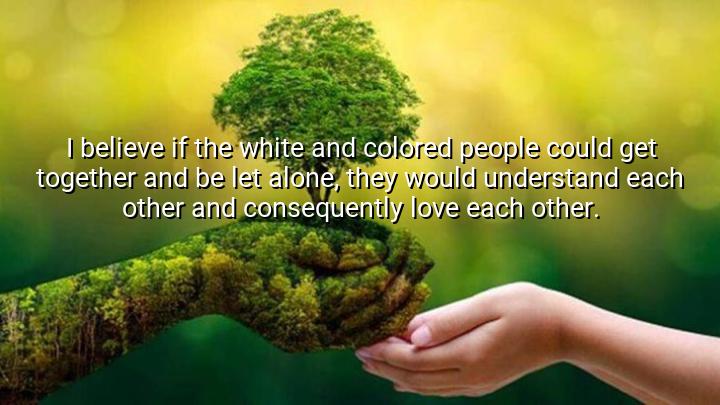




The quote "I believe if the white and colored people could get together and be let alone, they would understand each other and consequently love each other." by Josephine Baker reflects her deep belief in the power of unity and understanding between races. Baker suggests that racial harmony is achievable if people are allowed to come together without the interference of societal prejudices or racial divisions. She emphasizes that once individuals from different racial backgrounds can interact and truly get to know each other, they will be able to understand one another’s experiences and, as a result, develop mutual respect and love.
Baker’s statement also speaks to the idea that prejudices and stereotypes are learned behaviors, often enforced by society and external pressures. If individuals are allowed to interact freely and without fear, they would naturally come to see each other as equals, devoid of the racial barriers that separate them. Her belief in the potential for mutual understanding reflects a hope for a future where people of all races can live in peace and harmony, without the divisions that lead to conflict and discrimination.
This quote also underscores Baker's advocacy for racial equality and her lifelong commitment to breaking down racial barriers. As an African American entertainer and civil rights activist, Baker used her platform to challenge racism and to promote a vision of unity and coexistence among all people, regardless of race. Her statement is a call for greater dialogue and connection between the races, which she saw as essential for fostering a more just and compassionate society.
The origin of this quote comes from Josephine Baker, an iconic African American dancer, singer, and actress, known for her groundbreaking performances in France and her outspoken advocacy for racial equality. Baker’s influence extended beyond entertainment as she became an active participant in the civil rights movement. Her belief in the transformative power of human connection and her work in promoting racial unity made her an enduring symbol of freedom, equality, and cultural exchange.

XBXoai Bap
I’m curious how Baker’s view aligns with current social movements advocating for both separation and integration at different levels. Is there a tension between preserving cultural identity and fostering unity? How can communities respect individuality while also embracing shared humanity? This quote opens up complex discussions about coexistence, respect, and love across racial lines.
TDXuan Thach Do
This quote highlights the power of love as an outcome of understanding between races. But what role do education, media, and leadership play in shaping perceptions that either foster or hinder this love? Can love and understanding flourish in environments still marked by inequality and injustice? Baker’s words challenge us to consider the deeper foundations of racial harmony.
KKKARAOOKE KARAOOKE
Baker’s statement raises a question about the role of time and distance in healing divisions. Can simply being ‘let alone’ reduce fear and mistrust, or is proactive effort needed to build bridges? How might this idea be challenged by communities that thrive on interaction and shared experiences? It’s a nuanced conversation about the dynamics of race relations.
NNgan
Reading this, I’m struck by the optimism in Baker’s belief despite historical and ongoing racial tensions. What practical steps can be taken today to promote the kind of understanding she envisions? Does her perspective suggest that systemic structures, rather than personal attitudes, are the main obstacles to harmony? This quote invites reflection on both personal and institutional responsibilities in racial reconciliation.
Pphuc
This quote makes me think about the barriers to interracial understanding that go beyond mere proximity. Does ‘being let alone’ imply freedom from judgment and prejudice? How can societies create spaces where different communities feel safe enough to truly understand and love each other? It’s interesting to consider whether isolation or integration better fosters genuine connection.