

Human beings are not designed to be alone. None of God's creatures are.
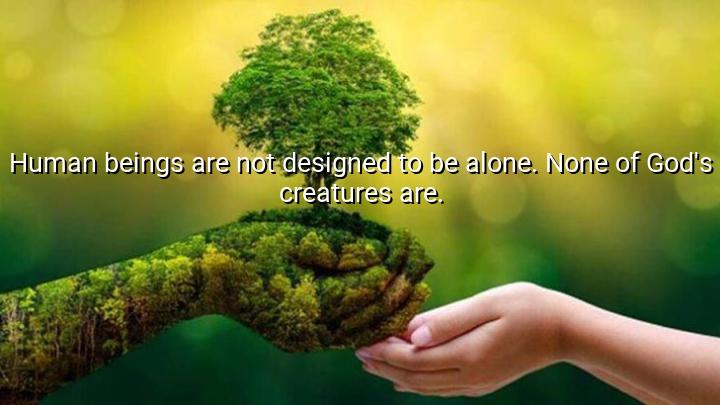




The quote "Human beings are not designed to be alone. None of God's creatures are." is from Chely Wright, an American country music singer and songwriter, who is also known for her advocacy in support of LGBTQ+ rights. In this statement, Wright emphasizes the inherent social nature of human beings, suggesting that people are not meant to live in isolation. She draws upon the idea that all of God's creatures, including humans, are created with a need for connection, whether with other humans or with the broader natural world.
Wright’s words align with the theological and philosophical belief that relationships and community are essential aspects of human life. By saying that we are "not designed to be alone," she suggests that the need for connection is a fundamental part of our nature. This perspective is often rooted in religious or spiritual teachings that underscore the importance of companionship, family, and community in fulfilling God's purpose for individuals.
The phrase "None of God's creatures are" expands this idea beyond humans, suggesting that interdependence is present in all forms of life. Wright is alluding to the notion that everything in creation is meant to exist in some form of relationship, whether through symbiosis, social bonds, or the interconnectedness of ecosystems. This idea reflects a broader worldview that sees unity and relationship as foundational principles in the universe.
In essence, Wright’s quote highlights the importance of connection in human existence and suggests that loneliness is contrary to the natural order of life. It reflects the belief that community and companionship are not merely social choices but are essential to human well-being and fulfillment. By drawing on the idea that none of God's creatures are designed to be alone, she emphasizes the universal need for relationships in all forms of life.

NQDam Nhu Quynh
I find this quote both comforting and challenging. Comforting because it validates the deep human need for love and belonging—but challenging because it reminds me how often we fail to meet that need in others. If none of us are meant to be alone, how do we reconcile that with the way society often ignores the lonely, the elderly, or the marginalized? It feels like a moral call to action.
H.7A9_12_TRAN NGOC TRUNG HIEU ._?
Wright’s words made me reflect on people who claim to prefer being alone. Are they truly content—or just protecting themselves from hurt, rejection, or disappointment? Is solitude ever a genuine lifestyle, or is it often a defense mechanism? It’s tricky, because some people feel empowered alone, but maybe even they need connection more than they’re willing to admit.
GLGioi Le
This quote hits home, especially in a time when digital life can make you feel connected and completely alone at the same time. If we’re truly not meant to be alone, then are virtual connections enough? Or do we need physical, emotional presence to feel truly seen? It raises a hard question—what’s missing in modern forms of communication that leaves people so lonely?
THkim tuong huy
I love the inclusiveness in this quote, especially the idea that no creature—not just humans—was made to live in isolation. It makes me wonder how much loneliness we project onto animals too. Do pets help remind us of our need for company? And on a broader level, what does this say about how we should structure our communities, relationships, and even workplaces?
NSnhap sudungdedang
Wright’s quote touches on something deeply emotional. I’ve always felt that loneliness is one of the most painful human experiences, and this reminds me that it’s not just hard—it’s unnatural. But then, why do so many people struggle with asking for help or seeking companionship? If we’re meant to be connected, what’s keeping us apart? Is it pride, fear, or just the pace of life?