

Higher education must lead the march back to the fundamentals of human relationships, to the old discovery that is ever new, that man does not live by bread alone.
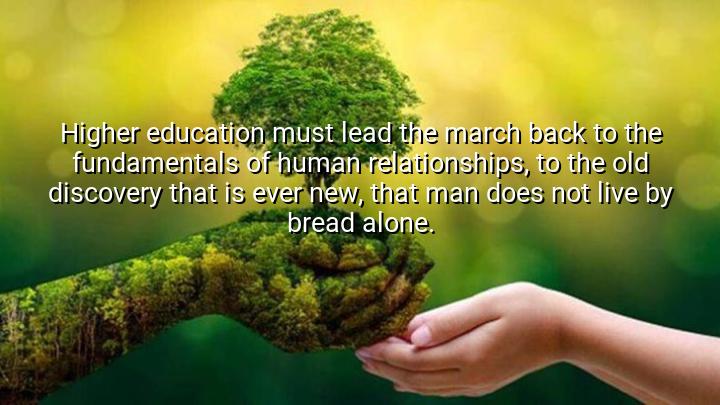




The quote "Higher education must lead the march back to the fundamentals of human relationships, to the old discovery that is ever new, that man does not live by bread alone." by John Hannah speaks to the deeper purpose of higher education beyond just providing technical or professional skills. Hannah argues that education should reconnect individuals with the fundamentals of human relationships and humanity itself. It is not enough to focus solely on intellectual or material success; education must also nurture our emotional, moral, and social well-being.
Hannah's reference to "man does not live by bread alone" is a biblical allusion to the idea that physical sustenance alone cannot fulfill the true needs of a person. It suggests that while material things such as food or wealth are necessary, they are not sufficient for a meaningful and fulfilling life. Higher education, according to Hannah, should focus on teaching the importance of human connection, compassion, and the broader spiritual and intellectual needs of individuals.
The quote emphasizes the idea that education should not just prepare individuals for the workforce, but also encourage them to develop a sense of purpose, a deeper understanding of community, and a focus on personal growth. It is a call for higher learning institutions to foster a holistic view of the human experience, recognizing that true fulfillment comes from developing not just the mind, but also the heart and spirit.
The origin of this quote comes from John Hannah, an American educator and leader in higher education. As a prominent figure in the Christian academic community, Hannah often emphasized the need for education to focus on both intellectual and ethical growth. This quote reflects his belief that education should go beyond mere career preparation and engage students in learning that nurtures their humanity and moral responsibility.

HBHuong Bui
Hannah’s words resonate with current debates on education’s role in society. Should higher education act as a catalyst for rediscovering timeless human truths? How can academic institutions create environments that emphasize collaboration, respect, and empathy? Could this shift also improve mental health and social cohesion on campuses? What examples exist of schools successfully integrating these ideals?
HHHau Hoang
This quote challenges us to rethink the goals of higher education in the modern world. With increasing focus on technology and innovation, how do we ensure that the development of human values keeps pace? Can universities lead societal change by prioritizing interpersonal skills and community engagement? How might students benefit personally and professionally from such an approach?
LNVu Nguyen Linh Ngoc
The idea that man does not live by bread alone reminds me of how education shapes character, not just intellect. How do educators inspire students to value relationships and ethical considerations alongside academic achievement? Could a renewed emphasis on human connection in education foster more compassionate leaders and citizens? What role should educators play in this transformation?
DLDoan Le
Hannah’s perspective invites reflection on what’s missing in many educational systems. Are current curricula too focused on ‘bread’—skills and knowledge—while neglecting ‘not bread alone’—emotional intelligence, community, and moral grounding? How might integrating philosophy, arts, or service learning enrich education? What barriers exist to implementing such changes, and how might they be overcome?
CLChi Luong
This quote raises important questions about the purpose of education. Should higher learning aim solely at preparing students for economic success, or is there a deeper responsibility to cultivate their humanity? How do we measure success in education beyond grades and job placement? Could reviving focus on human fundamentals address societal issues like polarization and loneliness?