

Here we are, we're alone in the universe, there's no God, it just seems that it all began by something as simple as sunlight striking on a piece of rock. And here we are. We've only got ourselves. Somehow, we've just got to make a go of it. We've only ourselves.
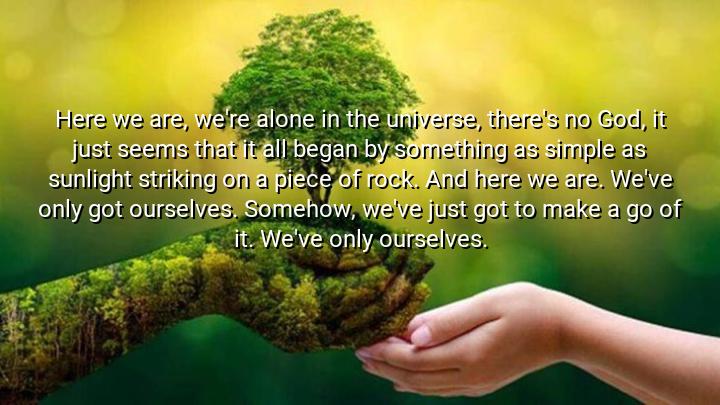




In this quote, John Osborne reflects on the existential nature of human life, expressing a sense of isolation and the lack of divine intervention. He contemplates the idea that humanity is alone in the universe, with no God or higher power guiding or watching over us. According to Osborne, life may have begun from something as simple as sunlight striking on a piece of rock, suggesting that the origin of existence is a natural and almost accidental phenomenon, rather than a divinely orchestrated event.
Osborne's words convey a sense of human responsibility in a world where we can no longer rely on external forces or divine guidance. He stresses that, in the end, it is only ourselves that we have to rely on. The idea of self-reliance and taking ownership of our existence comes through strongly in his statement that we must "make a go of it," implying that we must make the best of our circumstances despite the challenges or uncertainty.
The origin of this quote lies in John Osborne’s writings and his outlook on life. As a playwright and author known for his sharp social commentary, Osborne often explored themes of alienation, individualism, and the struggles of human existence. His works, such as Look Back in Anger, often reflect a sense of frustration with societal expectations and the absence of a guiding moral or spiritual framework.
In essence, Osborne's quote highlights the solitude of human existence, suggesting that we must come to terms with the idea that we are solely responsible for our lives and actions. Without the support of higher powers, the burden of meaning and purpose falls on our shoulders, leaving us to navigate life with only our own resolve and abilities.

HHnguyen huy hieu
This quote challenges traditional religious narratives by emphasizing human agency and solitude in the universe. How do people reconcile this with feelings of awe, wonder, or spirituality? Can the absence of God be a source of freedom rather than despair? I’d love to discuss how this worldview affects mental health, creativity, and our collective future.
NHNguyen Hang
Osborne’s statement feels like a call to action, reminding us that we have no external safety net. How might this urgency influence our priorities as individuals and societies? Does accepting that ‘we’ve only got ourselves’ lead to more compassion and cooperation, or could it foster isolation and competition? I’m interested in how this perspective impacts social and environmental ethics.
PHCUA HANG VLXD PHONG HOA
Reading this, I’m struck by the contrast between the simplicity of life’s origins and the complexity of human experience. Does the idea of starting ‘as simple as sunlight striking a rock’ diminish the awe we feel about life’s emergence, or enhance it by highlighting the miraculousness of natural processes? How does this shape our appreciation of existence and our responsibility toward one another?
D-Nguyen Quoc Dat -B18DCVT087
This quote raises profound questions about belief and meaning. Without a higher power, how do we create values and community? Can humanity truly thrive based on mutual support and self-reliance alone? I’d like to explore how secular worldviews foster hope and connection in a vast, seemingly indifferent universe, and what role science and humanism play in this journey.
VTLe Van Thang
John Osborne’s perspective on human existence, stripped of divine influence, feels both sobering and empowering. How do people find meaning and purpose when faced with the idea that we are entirely responsible for ourselves? Does this viewpoint encourage greater personal accountability or lead to existential anxiety? I’m curious how different philosophies and cultures approach this challenge of making ‘a go of it’ alone in the universe.